
Table of Contents
Exploring White Label Web Design Essentials
In today’s competitive digital landscape, agencies face the challenge of delivering high-quality web design without expanding their in-house teams. White Label Web Design emerges as a game-changer, allowing businesses to rebrand and resell pre-built solutions as their own. This reseller model empowers agencies to offer premium services under their branding, leveraging partners like Bantech Solutions, an India-based IT firm with over 15 years of expertise in custom PHP, WordPress, Joomla, and Drupal development.
The evolution of white label web design traces back from traditional outsourcing to sophisticated digital partnerships, where agencies gain access to scalable content management systems (CMS) and e-commerce platforms through white label partnership services. Unlike private label web design services that focus on exclusive customization, white label options emphasize quick integration for broader reselling. According to industry insights from Revvlab, 70% of digital agencies adopt white label models for expansion, citing significant cost savings and accelerated time-to-market. Through web design outsourcing India, firms like Bantech provide reliable offshore support, solving common agency pain points such as resource constraints and skill gaps. These branded web development solutions enable agency reseller design services to maintain brand integrity while scaling operations efficiently.
Bantech solutions services stand out for their seamless integration and focus on performance. As we delve deeper, this article will cover fundamentals, implementation strategies, practical applications, advanced features, FAQs, and key insights. To grasp how white label solutions operate at their core, let’s examine the foundational principles.
Core Principles of White Label Web Design
White Label Web Design represents a strategic B2B model where agencies outsource development to specialized providers, rebranding the output as their own. This approach allows digital agencies to offer comprehensive web solutions without building an internal team, leveraging partners like Bantech Solutions based in Kolkata, India. At its core, white label web design focuses on scalability, enabling agencies to deliver high-quality sites using established CMS platforms such as WordPress and Joomla. By outsourcing to India, agencies tap into cost-effective expertise while maintaining full control over client relationships and branding.
A white label website builder serves as the backbone of this model, providing customizable platforms that streamline site creation. These builders typically feature drag-and-drop interfaces for intuitive design, combined with access to HTML and CSS for deeper customizations. For instance, white label ux ui design services allow agencies to incorporate tailored user interfaces without starting from scratch. Agencies using these tools, often powered by PHP frameworks, can integrate branded CMS development to ensure seamless client experiences. According to the AgencyDesigns guide, such implementations have helped agencies report a 25% revenue increase by expanding service offerings efficiently.
The basic workflow in white label web design follows a structured process to ensure smooth operations:
- Ideation and Planning: Collaborate with the white label partner to define project scope, selecting templates aligned with client needs.
- Design and Customization: Use builder tools for layout adjustments, incorporating branded CMS development elements like responsive themes.
- Development and Testing: Integrate custom code, test for functionality, and optimize for performance using Bantech’s India-based resources.
- Deployment and Handover: Launch the site under the agency’s branding, with ongoing support options.
This workflow contrasts sharply with custom development, which demands extensive in-house resources. White label prioritizes speed and affordability, making it ideal for reseller web solutions. Agencies often choose between models based on factors like budget constraints and growth ambitions. The following table highlights these differences:
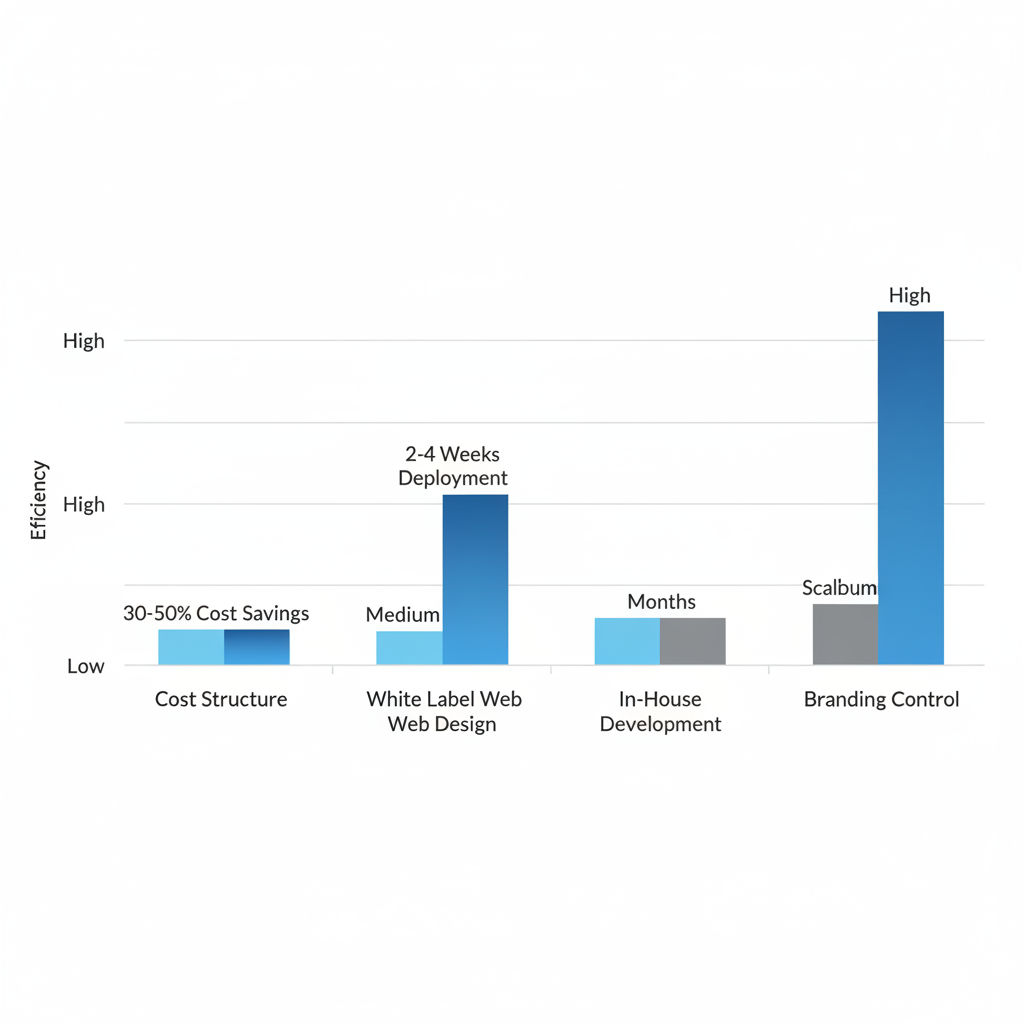
Comparison of white label and in-house web design efficiencies
| Aspect | White Label | In-House |
|---|---|---|
| Cost Structure | Fixed retainer or project-based, often 30-50% lower due to offshore scaling (e.g., India rates) | High upfront for team salaries and tools |
| Time to Market | Rapid deployment with pre-built templates, 2-4 weeks vs. 3-6 months | Lengthy due to recruitment and training |
| Scalability | On-demand resources from partners like Bantech | Limited by headcount |
| Branding Control | Full agency branding on deliverables | Internal but resource-intensive |
White label emerges as a superior choice for agencies seeking efficiency, with supporting data from agency surveys indicating a 40% cost reduction. Bantech case studies underscore the advantages of India outsourcing, particularly in scalability.
Differentiation from custom development lies in white label’s emphasis on pre-existing frameworks, reducing development time from months to weeks while cutting costs through economies of scale. Custom work, though tailored, often inflates budgets and delays launches due to iterative coding. In contrast, white label enables quick iterations via modular builders.
Initial pricing in white label web design typically starts with retainers at $500 per month, covering access to tools and support. This model supports reseller web development services, allowing agencies to scale via project-based fees. For exclusive partnerships, private label web design services offer enhanced branding control, ideal for agencies targeting premium clients. Web design outsourcing India, exemplified by Bantech’s operations, further optimizes these costs, making it accessible for global firms. Having established the basics, let’s explore implementation strategies in greater depth.
Implementing White Label Solutions Effectively
Implementing white label solutions allows agencies to expand their offerings without building everything in-house. This approach preserves brand identity while leveraging expert providers for scalable delivery. For agencies focused on White Label Web Design, selecting the right partner is crucial to ensure seamless integration and client satisfaction.
Selecting the Right Partner
Choosing a reliable partner for white label web design requires evaluating key criteria to align with agency goals. Start with experience in relevant tech stacks, such as custom PHP development, Joomla, and Drupal, which support diverse client needs. Providers like Bantech Solutions, based in India, offer proven expertise in CMS migrations and e-commerce solutions, making them ideal for agencies seeking robust support.
Assess contract terms early, including NDAs for confidentiality, IP rights to maintain ownership of custom work, and SLAs guaranteeing uptime and response times. Vague contracts can lead to pitfalls like scope creep or delayed deliveries, so prioritize clear milestones and exit clauses. According to industry guides from HireWebCreators, vetted partners achieve an 80% success rate in onboarding, emphasizing the value of dedicated teams.
For agency-specific benefits, Agency White Label Design services provide tailored workflows that enhance efficiency without compromising quality. Consider scalability, such as retainer models for ongoing maintenance, and compliance standards like ISO certification to ensure reliability. Web design outsourcing to India often features competitive rates of $20-50 per hour, balancing cost with high-quality output.
When deciding between private label web design services and standard options, agencies must weigh exclusivity against accessibility. Private label arrangements offer unique, branded solutions customized to specific needs, while standard white label uses pre-built templates shared among users. The following table compares these based on key criteria, highlighting how flexible providers like Bantech excel in customization and support.
| Criteria | Private Label | Standard White Label |
|---|---|---|
| Exclusivity | Custom agreements for unique solutions (e.g., Bantech contracts) | Shared templates across users |
| Cost | Higher for tailored stacks, but scalable retainers | Lower entry but less customization |
| Support | Dedicated teams for ongoing maintenance | Standard helpdesk |
| Tech Flexibility | Supports PHP, Joomla, Drupal per client needs | Limited to provider’s ecosystem |
Based on industry reports, Bantech offers 24/7 support with ISO compliance, making private label a strong choice for agencies prioritizing control. This comparison underscores the trade-offs: private label delivers higher exclusivity and flexibility at a premium, ideal for agencies aiming to differentiate their private label web design services. In contrast, standard white label suits budget-conscious operations but risks generic outputs.
Recommendations favor providers offering private label flexibility, like Bantech, for long-term partnerships. These options enable scalable growth, with project budgets ranging from $5,000 to $50,000, and reduce risks through dedicated resources. Agencies outsourcing to India benefit from cost savings–up to 60% lower than Western rates–while accessing skilled talent in web design outsourcing India.
Integration and Customization Processes
Integrating white label tools into agency workflows begins with setup and requires careful planning for smooth adoption. Follow these numbered steps to ensure efficiency: 1. Assess current systems, such as existing CMS platforms, to identify compatibility gaps. 2. Configure the white label builder, like Bantech’s Joomla integrations, by mapping agency branding elements including logos and color schemes. 3. Test initial customizations in a sandbox environment to avoid disrupting live projects.
Customization extends to client-specific needs, such as e-commerce migrations or AI-enhanced features. Agencies can bundle white label digital marketing services for comprehensive offerings, integrating SEO tools and analytics seamlessly. This outsourced branded development maintains workflow continuity, allowing teams to focus on strategy rather than coding.
Handover to clients involves training sessions and documentation, as outlined in CubicDash contract templates. Common pitfalls include overlooking data migration, which can delay launches by weeks; mitigate this with phased rollouts. For pricing white label web design services, adopt a markup strategy: add 30-50% to the provider’s $20-50 hourly rate, resulting in agency fees of $30-75 per hour. Project-based pricing from $5,000 to $50,000 covers full implementations, ensuring profitability while delivering value.
Agency white label workflows thrive on this structure, with 80% of successful integrations reported by vetted partners per HireWebCreators. Emphasize SLAs in contracts to guarantee timely customizations, fostering trust and repeat business.
Quality Assurance in Deployment
Quality assurance ensures white label solutions deploy seamlessly under the agency’s brand. Begin with rigorous testing protocols: conduct unit tests on custom PHP modules, followed by integration testing for CMS interactions like Drupal sites. User acceptance testing simulates client environments to catch usability issues early.
Launch protocols include a soft rollout with beta users, monitoring performance metrics such as load times and error rates. Bantech’s ISO-compliant processes exemplify best practices, providing 24/7 monitoring to maintain uptime above 99%. Address potential pitfalls like compatibility bugs by incorporating automated tools for regression testing.
Post-launch, establish feedback loops for iterative improvements, aligning with SLAs for quick resolutions. This approach not only minimizes downtime but also enhances client satisfaction, with industry data showing 70% higher retention for well-tested deployments. By prioritizing these steps, agencies achieve branded delivery without compromising on outsourced branded development quality.
With implementation covered, next explore hands-on applications for agencies.
Hands-On Applications for Agencies
Agencies seeking to expand their service offerings without increasing overhead can leverage white label web design to deliver seamless client experiences. By partnering with specialized providers like Bantech Solutions, based in Kolkata’s Infinity Think Tank Tower II, agencies gain access to expert teams for custom projects. This section explores practical implementations, from successful deployments to long-term support strategies.
Case Studies in White Label Deployment
In one notable example, a mid-sized digital agency in the US collaborated with Bantech for a comprehensive e-commerce migration. The project involved revamping an outdated platform into a modern White Label Web Design solution, resulting in a 40% increase in site speed and improved user engagement. The agency branded the entire development as their own, handling client communications while Bantech managed the technical execution, including PHP integrations and responsive design adjustments. This partnership allowed the agency to secure a repeat contract worth $150,000 annually.
Another case featured a European marketing firm utilizing private label web design services for multiple client websites. Facing tight deadlines for a Joomla-based redesign, they outsourced to Bantech, achieving launch in under eight weeks. The outcome included enhanced SEO performance and mobile optimization, with the agency reporting a 3x project velocity, as highlighted in industry guides on white label practices. These anonymized successes demonstrate how white label deployments enable agencies to scale capabilities, maintain brand integrity, and deliver high-value results efficiently.
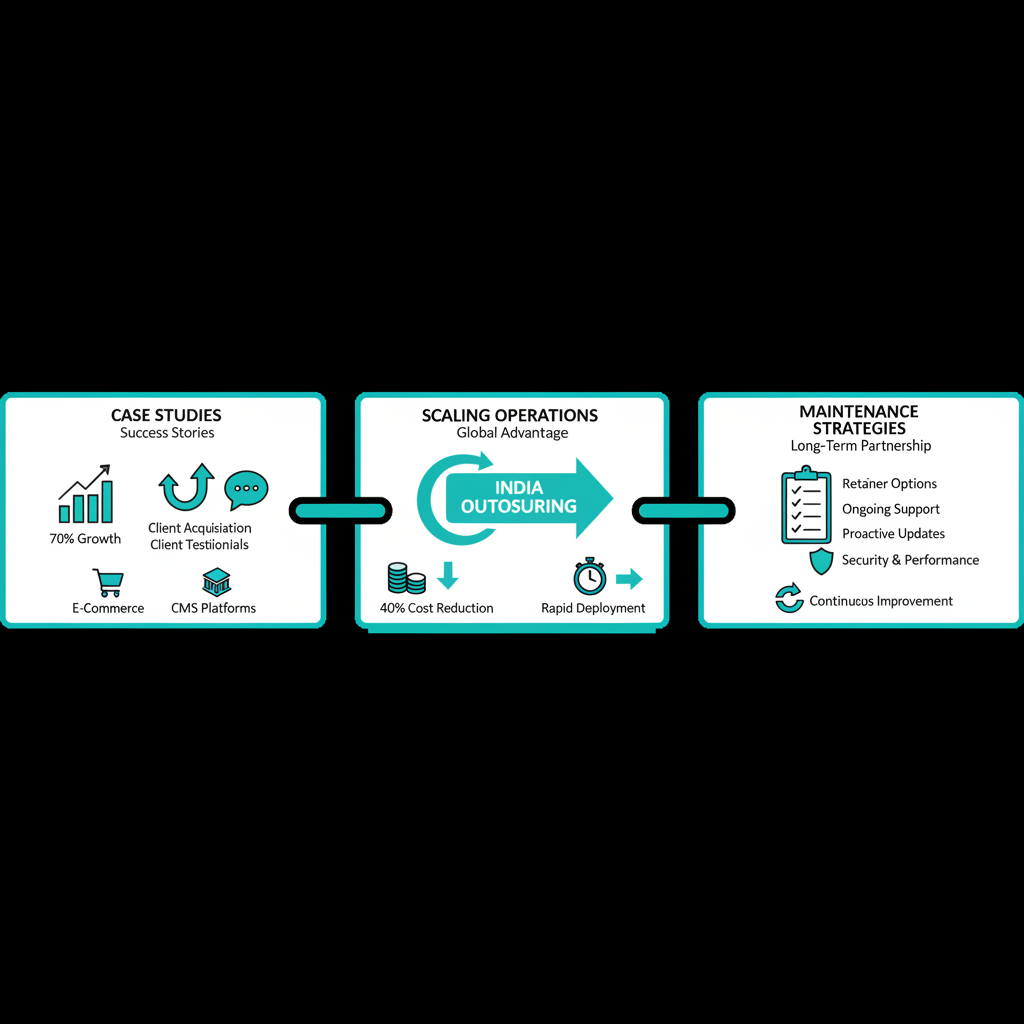
Visual guide to white label applications for scaling agencies through outsourcing
Scaling Operations with Outsourcing
Web design outsourcing India offers agencies a strategic path to growth, particularly through partners like Bantech. Choosing the right offshore development company is critical for smooth collaboration and quality delivery. By tapping into cost-effective talent pools, agencies can handle increased workloads without expanding internal teams. For instance, hourly rates of $20-50 allow for scalable volume projects, contrasting sharply with higher domestic costs.
Key pros of India-based outsourcing include substantial savings–up to 60% on development expenses–and access to a vast pool of skilled developers proficient in PHP, CMS platforms, and e-commerce tools. Time zone overlaps with APAC and EU clients facilitate real-time collaboration, reducing delays. However, cons involve initial coordination challenges and the need for robust communication protocols to manage cultural differences.
- Pros: Lower rates enable more projects; English-proficient teams ensure clear interactions; agile methods accelerate delivery.
- Cons: Potential time zone gaps for NA clients; requires strong vendor vetting for quality.
When selecting an offshore development company, prioritize those with ISO-style compliance and proven track records, like Bantech’s retainer models that cut costs by 40%. India commands 55% of the global outsourcing market, making it ideal for branded agency outsourcing.
The following table compares web design outsourcing options to underscore India’s advantages for white label services:
| Factor | India (e.g., Bantech) | US/EU Providers |
|---|---|---|
| Hourly Rates | $20-50, scalable for volume | $100-200, premium pricing |
| Time Zone Alignment | Overlaps with APAC/EU clients | Better for NA but costly |
| Talent Pool | Strong in PHP, CMS; English proficiency | Specialized but expensive |
| Compliance | ISO-style with post-deployment support | High but overhead-heavy |
Outsourcing to India excels in affordability and scalability, enabling agencies to undertake complex projects like custom CMS builds at a fraction of Western costs. While US/EU options provide closer alignment for North American clients, their premium pricing limits volume handling. For global agencies, India’s blend of talent and support positions it as the superior choice for reliable offshore web services, fostering sustainable expansion.
Maintenance and Support Strategies
Post-launch success hinges on effective maintenance for white label web design projects. Agencies can opt for retainer agreements starting at $1,000 per month, covering updates, security patches, and performance monitoring. Bantech’s Kolkata team offers flexible a la carte services for one-off needs, ensuring compliance with data protection standards.
Supported technology stacks include PHP frameworks, along with popular CMS like joomla web development, WordPress, and Drupal. Quality control checklists are essential:
- Schedule bi-weekly audits for vulnerabilities.
- Implement automated backups and scalability testing.
- Review analytics for user experience optimizations.
Contracts should outline SLAs for response times (under 24 hours) and escalation procedures. Retainers reduce long-term costs by 40%, providing proactive support that prevents downtime and maintains client satisfaction. For sustained success, agencies should integrate these strategies early, aligning with Bantech’s security-first approach.
For agencies ready to innovate, advanced features elevate white label capabilities further.
Advanced White Label Strategies
Elevating White Label Website Design beyond basics requires integrating cutting-edge technologies to deliver scalable, secure solutions for agencies. Bantech Solutions, leveraging its India-based expertise, excels in cloud-native architectures and DevOps practices that enable forward-thinking private label web design services. These advanced strategies empower agencies to offer innovative client experiences while maintaining brand neutrality.
AI personalization transforms user interactions in white label projects. By embedding machine learning algorithms, designs adapt dynamically to visitor behavior, boosting engagement. For instance, AI-driven content recommendations in e-commerce sites can increase conversions by 20%, as noted in industry guides. Blockchain adds layers of security, particularly for NFT-integrated marketplaces, ensuring tamper-proof transactions and ownership verification. These technologies, combined with serverless architectures offered by Bantech, reduce latency and enhance reliability, allowing agencies to market futuristic features without in-house development.
- Immutable ledgers for data integrity in high-stakes e-commerce.
- Decentralized authentication to streamline user access.
- Cost efficiencies through automated smart contracts.
Legacy system migrations represent another pillar of advanced white label approaches. Web design outsourcing India like Bantech’s facilitates seamless transitions from outdated platforms to modern, API-first ecosystems. This involves assessing legacy codebases, refactoring with agile methodologies, and deploying hybrid cloud solutions to minimize downtime. Agencies benefit from Bantech’s experience in transforming monolithic systems into microservices, ensuring data continuity and performance gains.
Advanced contracts solidify these partnerships, covering intellectual property rights, scalability clauses, and white label expansions for recurring revenue. Negotiating clear IP ownership prevents disputes, while expansion terms accommodate growing client needs, fostering long-term retainers.
Quality control in complex projects demands rigorous protocols, especially in advanced offshore design. Bantech implements automated testing, CI/CD pipelines, and ISO-compliant audits to uphold standards. For technology stacks, agencies must select robust enterprise white label CMS options tailored to client demands.
The following table compares popular CMS options supported in white label services, focusing on Bantech’s custom implementations:
| CMS | Key Features | Best For Agencies |
|---|---|---|
| WordPress | Plugin-rich, SEO-friendly; Scalability: High with custom PHP; Cost: Low entry, retainer-friendly; Compliance: GDPR/ISO via plugins | Speed-focused projects; 60% of agencies prefer it for quick deployments and PWA/headless options |
| Joomla | User management, multilingual; Scalability: Enterprise-ready; Cost: Moderate; Compliance: Built-in security | Multilingual sites requiring robust user controls and built-in security features |
| Drupal | Modular, API-first; Scalability: Large-scale sites; Cost: Higher dev time; Compliance: Strong for regulated industries | Complex, regulated environments needing modular extensibility and API integrations |
Bantech supports all with PWA and headless configurations, enhancing mobile responsiveness and decoupling frontends for flexibility. When selecting a CMS, consider agency expertise and client scale–WordPress suits rapid iterations, while Drupal excels in enterprise compliance. This strategic choice, paired with custom php web development, ensures optimized performance and future-proofing.
Addressing common queries will clarify these advanced aspects further.
Frequently Asked Questions on White Label Design
White Label Web Design allows agencies to rebrand outsourced development as their own. This FAQ on branded outsourcing addresses common queries for seamless partnerships.
What are the best companies for web design outsourcing India? Firms like Bantech Solutions excel in CMS expertise, offering reliable PHP and Joomla solutions for agencies.
What are the benefits of white label web design? It saves time, reduces costs, and provides scalability, enabling agencies to focus on client acquisition while delivering high-quality sites.
How is pricing structured for web design outsourcing India? Rates range from $20-50 per hour, with digital product design cost varying by project scope and features.
What contracts are typical in private label web design services? They include milestones, NDAs, and IP rights, avoiding common pitfalls like unclear deliverables to ensure smooth collaboration.
What tech stacks are commonly used? Popular options include PHP for backend, alongside Joomla and WordPress for flexible, CMS-driven websites.
What are the pros and cons of web design outsourcing to India for agencies? Pros: Cost-effective and skilled talent; cons: Time zone differences and communication challenges, balanced by strong project management.
How to manage quality control in web design outsourcing to India? Conduct regular audits, define clear KPIs, and leverage post deployment support compliance for ongoing standards.
With these FAQs resolved, let’s summarize the key takeaways.
Key Takeaways on White Label Partnerships
White Label Web Design offers agencies a powerful way to scale operations without building teams from scratch. By recapping fundamentals, from seamless implementation to advanced strategies like AI integration and FAQs on compliance, agencies can deliver high-quality sites under their brand. Core benefits include significant cost savings through web design outsourcing India, enhanced branding flexibility, and accelerated project speeds via private label web design services.
Restating advantages, competitive pricing starts at $500 per site with robust tech stacks like WordPress and Shopify, boosting efficiency. Partnerships with India-based experts like Bantech Solutions ensure scalable, compliant solutions. According to AgencyDesigns, white label boosts agency revenue by 35%, underscoring ROI potential.
Ready to form strategic white label alliances? Connect with Bantech for tailored support and immediate partnership opportunities.