You are not here to learn what hyperautomation is. You already know it combines robotic process automation, artificial intelligence, process mining, low-code tooling, and intelligent document processing into a unified automation capability that can transform operations at scale. What you need now is simpler — and harder: which platform do you actually buy?
That question deserves a direct, honest answer. This guide cuts through the vendor marketing to compare the leading hyperautomation platforms on the criteria that actually drive enterprise purchasing decisions in 2026 — deployment architecture, AI maturity, total cost of ownership, integration breadth, governance and compliance controls, and real-world ROI benchmarks. We cover seven platforms in depth, score them against a decision matrix, and close with a framework to help you match the right platform to your specific organizational context.
Before we get into the comparisons, one framing point matters. The hyperautomation market reached USD 68.2 billion in 2026 and is projected to surpass USD 278 billion by 2035. That explosive growth has attracted a crowded field of vendors, each claiming leadership across every capability. The reality is that no single platform leads in every dimension, and the right choice for a global financial institution automating high-volume, compliance-sensitive workflows is almost never the right choice for a mid-market healthcare organization prioritizing rapid deployment and citizen developer adoption. Fit matters more than features.
What Separates a Hyperautomation Platform from an RPA Tool

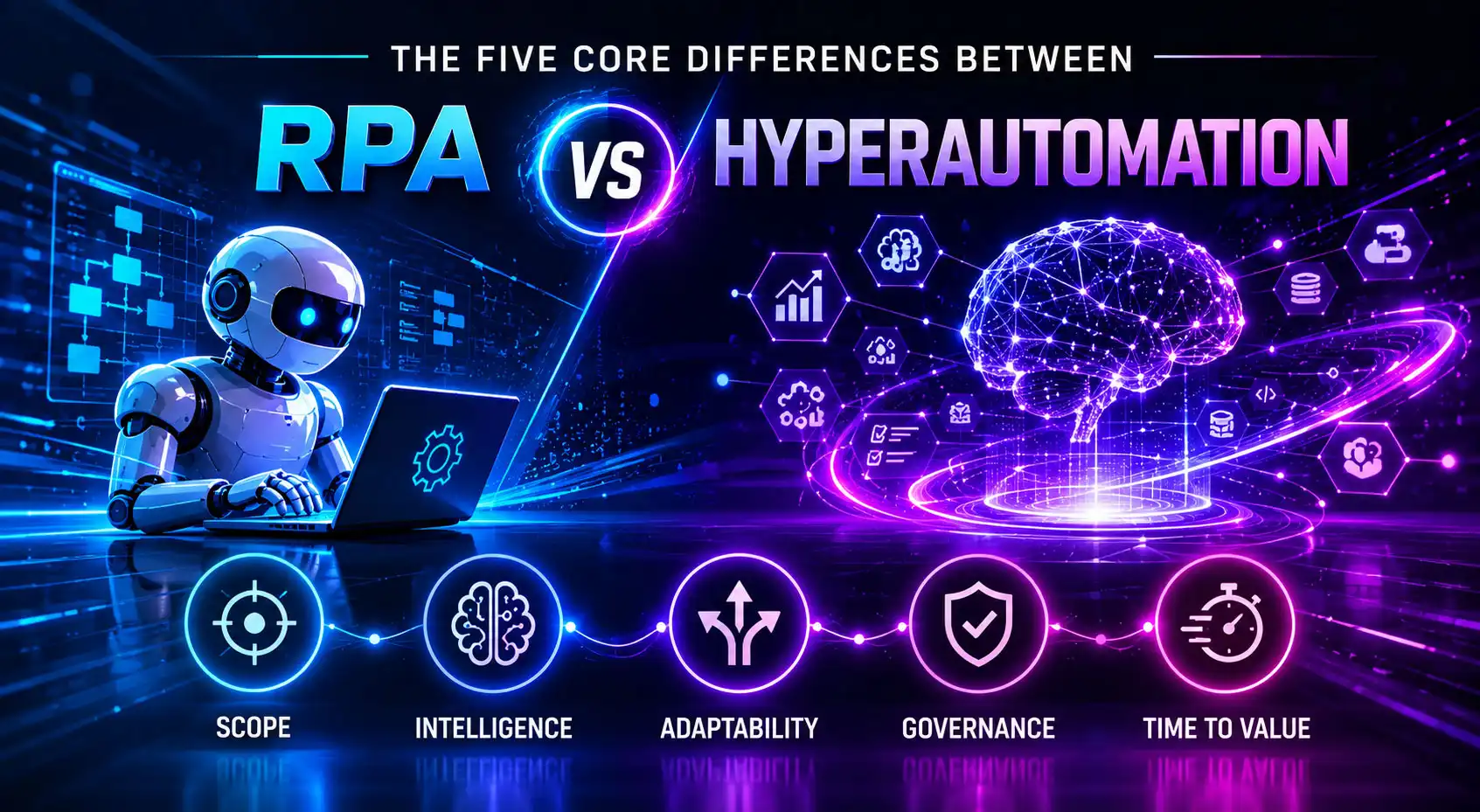
Before comparing platforms, it is worth being precise about what qualifies as a genuine hyperautomation platform versus a point automation tool with an expanded feature set. As we’ve covered in depth in our RPA vs Hyperautomation guide, the distinction matters significantly for buyers.
A true hyperautomation platform integrates at minimum the following capabilities in a single, governed environment:
Process and task discovery — the ability to analyze existing system logs and user behavior to identify and prioritize automation opportunities objectively, without relying solely on stakeholder interviews.
Robotic process automation — both attended and unattended bot execution across desktop and web environments, with a mature orchestration layer for managing bot fleets at scale.
AI and machine learning integration — native natural language processing, intelligent document processing, computer vision, and decision intelligence — not just third-party connectors to external AI services, but integrated ML capabilities that can be configured and governed within the platform.
Low-code and no-code process development — accessible process design tools that allow business users to build and modify automations without depending entirely on IT, including visual workflow builders, pre-built connectors, and reusable component libraries.
Analytics and continuous improvement — dashboards, ROI tracking, process conformance monitoring, and bot performance analytics that provide ongoing visibility into automation value and identify opportunities for optimization.
Governance, security, and compliance controls — role-based access control, audit trails, credential vaulting, change management workflows, and compliance reporting capabilities appropriate for regulated industries.
Platforms that cannot credibly deliver all six of these capabilities in an integrated way are not hyperautomation platforms — they are RPA tools with ambitions. Keep that test in mind as you evaluate vendor claims.
The 2026 Enterprise Hyperautomation Platform Landscape
The market in 2026 has consolidated significantly around a handful of platforms that have achieved genuine hyperautomation maturity. Here is the field that matters for enterprise buyers.
1. UiPath
Best for: Large enterprises with complex, high-volume automation programs requiring deep AI integration and an active developer community.
UiPath has maintained its position as the market’s most mature platform through aggressive investment in its AI capabilities. The platform’s 2025 and 2026 releases have been defined by deep integration of generative AI into the automation lifecycle — from AI-assisted process discovery to natural language-driven bot development that allows developers to describe an automation in plain English and have the platform generate the underlying workflow code.
Core strengths: UiPath’s process mining capability, acquired through its integration of Process Gold, is now one of the most capable on the market. Its AI Center provides a managed environment for deploying, governing, and monitoring machine learning models within automation workflows — a critical differentiator for enterprises that need to maintain model governance alongside bot governance. The platform’s marketplace ecosystem is the largest in the industry, with thousands of pre-built components that dramatically reduce development time for common enterprise processes.
Limitations: UiPath carries the highest total cost of ownership in the market for most configurations. Licensing is complex, and organizations frequently report that their actual spend exceeds initial projections as they scale. The platform’s depth is also its complexity — organizations without experienced automation teams or implementation partners tend to have difficult early experiences.
Typical ROI timeline: 12–18 months to positive ROI on enterprise deployments, though early-win automations can show payback in 3–6 months.
Pricing: Enterprise licensing starts at approximately $48,000 per year for mid-scale deployments, scaling significantly with bot count, process complexity, and AI feature usage. Always negotiate — UiPath’s enterprise deals are highly flexible.
2. Automation Anywhere (AA360)
Best for: Organizations prioritizing cloud-native architecture, strong security credentials, and accessible citizen developer programs.
Automation Anywhere’s AA360 platform has made cloud-native architecture its defining competitive position. While UiPath and Blue Prism both offer cloud deployment options, Automation Anywhere built its current platform from the ground up for cloud-first operation — and it shows in the deployment experience, scalability, and integration model.
Core strengths: AA360’s Document Automation capability — its intelligent document processing stack — is among the strongest in the market, particularly for complex, semi-structured documents like contracts, purchase orders, and insurance forms. The platform’s AARI (Automation Anywhere Robotic Interface) is one of the most polished attended automation experiences available, making it strong for customer-facing use cases and processes that require human-in-the-loop decision making. Security credentials are genuinely enterprise-grade, with FedRAMP authorization making it one of the few platforms suitable for U.S. federal deployments.
Limitations: Automation Anywhere’s partner ecosystem and pre-built component marketplace are smaller than UiPath’s, meaning more custom development for complex integrations. Its process mining capability, while functional, lags behind UiPath and Celonis in depth and sophistication.
Typical ROI timeline: 10–16 months for full-scale deployments; faster for document-heavy use cases.
Pricing: Cloud subscription pricing is generally more transparent than UiPath. Mid-market deployments typically range from $35,000–$80,000 annually, with enterprise pricing negotiated per contract.
3. Microsoft Power Automate + Azure AI
Best for: Microsoft-centric organizations seeking deep ecosystem integration, rapid deployment, and the broadest accessible automation capability.
Microsoft’s hyperautomation story in 2026 is compelling primarily for organizations already invested in the Microsoft ecosystem — and most enterprises are. Power Automate, combined with Azure AI Services, Copilot Studio, and the broader Power Platform, creates a genuinely capable hyperautomation environment with an integration advantage no competitor can match for Microsoft shops.
Core strengths: The integration depth with Microsoft 365, Teams, SharePoint, Dynamics 365, and Azure services is unmatched — and for organizations where a significant percentage of work happens in these environments, it creates immediate automation opportunities that dedicated RPA platforms struggle to replicate as smoothly. Copilot capabilities embedded directly into Power Automate allow business users to describe workflows in natural language and have the platform generate them, dramatically lowering the barrier to citizen developer adoption. Licensing through existing Microsoft Enterprise Agreements creates genuinely lower total cost of ownership for many organizations.
Limitations: Power Automate’s desktop RPA capability (Power Automate Desktop) lags behind UiPath and Automation Anywhere in enterprise-grade bot orchestration, credential management, and fleet management at scale. Organizations with significant legacy system automation requirements — particularly mainframe, thick-client, or complex Citrix environments — will hit real limitations. The platform is also less suitable as a standalone hyperautomation program if the goal is to build an enterprise-wide Center of Excellence that operates independently of Microsoft’s product roadmap.
Typical ROI timeline: Fastest initial deployment timelines in the market (weeks rather than months) for standard Microsoft ecosystem processes, with full program ROI typically within 8–14 months.
Pricing: Power Automate is often bundled with existing Microsoft M365 or Dynamics licenses at no additional per-user cost for certain tiers, with premium connectors and RPA capabilities starting at approximately $15/user/month, scaling to enterprise agreements.
4. Blue Prism (SS&C)
Best for: Regulated industries — financial services, insurance, healthcare, pharmaceuticals — where compliance, auditability, and enterprise governance are non-negotiable.
Following its acquisition by SS&C Technologies, Blue Prism has sharpened its focus on the highly regulated enterprise market where its governance architecture was always strongest. The platform’s philosophy — centralized, IT-governed, rigorously auditable automation — is a constraint in some contexts and an enormous advantage in others.
Core strengths: Blue Prism’s control room and governance architecture remains the industry benchmark for compliance-sensitive deployments. Every bot action is logged, every process change is tracked with full audit trails, and the platform’s design philosophy makes it extremely difficult to create automations that operate outside of governance controls — which is exactly what regulated industries need. Its intelligent automation capabilities have been strengthened significantly through acquisition of Thoughtonomy and development of its Chorus decision management platform.
Limitations: Blue Prism’s citizen developer story is the weakest in this comparison. The platform is designed for IT-governed automation and requires meaningful technical expertise to develop and maintain. Organizations seeking broad-based citizen developer programs should look elsewhere. The platform’s innovation pace has also slowed relative to competitors since the SS&C acquisition.
Typical ROI timeline: 14–24 months for full program ROI, consistent with its enterprise implementation complexity. Individual process automations can show payback more quickly.
Pricing: Enterprise licensing; publicly available pricing is limited. Expect $60,000–$120,000+ annually for meaningful enterprise deployments.
5. ServiceNow Automation Engine
Best for: Organizations with ServiceNow as an existing ITSM or workflow platform, seeking to extend automation across IT and business operations simultaneously.
ServiceNow has evolved from an IT service management platform into a genuine workflow automation and hyperautomation environment through its IntegrationHub, RPA Hub, and AI capabilities. For organizations where ServiceNow already serves as the operational backbone, the Automation Engine creates a compelling unified automation environment.
Core strengths: The integration between ITSM workflows, IT operations, and cross-functional business automation is genuinely differentiated — no other platform closes that loop as naturally. ServiceNow’s Now Intelligence AI layer provides solid NLP and predictive intelligence for service desk, HR, and operations automation. Its low-code App Engine makes it accessible to business developers building process automation on top of existing ServiceNow workflows.
Limitations: ServiceNow is most effective when automation is anchored to its platform workflows. Organizations seeking to automate large swaths of operations that live entirely outside ServiceNow’s sphere — manufacturing execution systems, complex financial systems, legacy mainframe environments — will find its RPA capabilities and integration breadth more limited than dedicated hyperautomation platforms.
Typical ROI timeline: 8–14 months for IT and ITSM-anchored use cases; longer for cross-functional programs requiring significant non-ServiceNow integration.
Pricing: Bundled into ServiceNow enterprise agreements; typically add-on pricing of $75,000–$200,000+ annually for meaningful Automation Engine deployments.
6. Pegasystems (Pega)
Best for: Customer-facing process automation, decisioning-heavy workflows, and organizations where AI-driven case management is central to the automation strategy.
Pega’s hyperautomation positioning centers on its combination of intelligent process management, AI-powered decisioning, and customer engagement automation. Where most hyperautomation platforms approach automation from a process efficiency angle — eliminate manual steps, reduce cycle time — Pega approaches it from a customer journey and business outcome angle, with automation as the mechanism that delivers decisions and actions at scale.
Core strengths: Pega’s AI decisioning engine is genuinely differentiated, particularly for customer service, marketing, insurance claims, and financial services workflows where the automation is not just executing steps but making contextual decisions about what action to take next. Its case management architecture handles process complexity and exceptions more gracefully than rule-based RPA approaches. The platform’s low-code development environment is mature and accessible to business process experts with modest technical backgrounds.
Limitations: Pega is not the right choice if the primary objective is process efficiency and cost reduction through high-volume, repetitive task automation. Its strength is intelligent, decision-heavy processes — deploying it for straightforward data entry elimination or ERP integration automation is expensive overengineering. Implementation complexity and cost are among the highest in the market.
Typical ROI timeline: 18–30 months for full program ROI, though specific use cases can demonstrate value much faster.
Pricing: Significant enterprise investment; typical deployments range from $150,000 to $500,000+ annually.
7. IBM Cloud Pak for Business Automation
Best for: Enterprises with heavy IBM infrastructure investment, complex content management requirements, and sophisticated business rules management needs.
IBM’s hyperautomation platform combines its RPA capabilities, Business Automation Workflow, Operational Decision Manager, and AI services into Cloud Pak for Business Automation — a comprehensive but complex offering targeted squarely at large enterprises with sophisticated needs.
Core strengths: IBM’s content management and document processing heritage gives the platform genuine strength in document-heavy industries — banking, insurance, government, and legal services. Its Business Rules Management capabilities are among the most mature in the market. The platform’s integration with IBM’s broader data, AI, and security portfolio creates a compelling story for organizations already in the IBM ecosystem.
Limitations: IBM’s platform carries significant implementation complexity and cost. It requires experienced IBM partners and internal expertise to deploy effectively. The user experience is less polished than UiPath or Automation Anywhere, and the platform’s innovation pace in AI-native capabilities has been slower than born-in-the-cloud competitors.
Typical ROI timeline: 18–30 months.
Pricing: Enterprise licensing through IBM agreements; expect $100,000–$300,000+ annually for meaningful deployments.
Platform Comparison Matrix
| Capability | UiPath | AA360 | Power Automate | Blue Prism | Service Now | Pega | IBM |
|---|
| RPA Maturity | ★★★★★ | ★★★★☆ | ★★★☆☆ | ★★★★★ | ★★★☆☆ | ★★★☆☆ | ★★★★☆ |
| AI / ML Integration | ★★★★★ | ★★★★☆ | ★★★★☆ | ★★★☆☆ | ★★★☆☆ | ★★★★★ | ★★★★☆ |
| Process Mining | ★★★★★ | ★★★☆☆ | ★★★☆☆ | ★★★☆☆ | ★★★☆☆ | ★★★☆☆ | ★★★☆☆ |
| Citizen Developer | ★★★★☆ | ★★★★☆ | ★★★★★ | ★★☆☆☆ | ★★★★☆ | ★★★★☆ | ★★★☆☆ |
| Enterprise Governance | ★★★★☆ | ★★★★★ | ★★★☆☆ | ★★★★★ | ★★★★☆ | ★★★★☆ | ★★★★☆ |
| Integration Breadth | ★★★★★ | ★★★★☆ | ★★★★★ | ★★★★☆ | ★★★★☆ | ★★★★☆ | ★★★★☆ |
| Ease of Implementation | ★★★☆☆ | ★★★★☆ | ★★★★★ | ★★☆☆☆ | ★★★★☆ | ★★☆☆☆ | ★★☆☆☆ |
| Total Cost of Ownership | ★★☆☆☆ | ★★★☆☆ | ★★★★★ | ★★★☆☆ | ★★★☆☆ | ★★☆☆☆ | ★★☆☆☆ |
★★★★★ = Market-leading | ★★★☆☆ = Competitive | ★★☆☆☆ = Lags market
|
How to Calculate ROI Before You Commit
One of the most common mistakes buyers make is evaluating platforms on feature comparisons without anchoring the decision to a concrete ROI model. Building that ROI model begins with rigorous process discovery — identifying which processes you plan to automate, quantifying the current cost of manual execution, and projecting realistic automation savings against implementation and licensing costs.
Here is a framework for a credible first-year ROI model:
Step 1: Identify your top 10 automation candidates. Use process mining data or structured process inventories to rank candidates by annual manual cost, automation suitability (volume, rule-based steps, digital inputs), and strategic priority.
Step 2: Calculate current manual processing cost. For each candidate process: (annual transaction volume) × (average handling time in hours) × (fully-loaded hourly cost of the employees performing the work). Include error-related rework, exception handling, and downstream impact costs where they are significant.
Step 3: Estimate automation savings. Apply realistic reduction factors based on the process type — typically 60–80% labor cost reduction for high-volume, rule-based processes; 30–50% for processes with significant exception rates or human judgment requirements. Do not use vendor-supplied “up to 80% cost reduction” figures as your base case.
Step 4: Model implementation and licensing costs. Include: platform licensing (first year and ongoing); implementation services (internal team time plus any external consulting); infrastructure costs; training; and ongoing bot maintenance (typically 15–25% of initial development cost annually).
Step 5: Calculate payback period. Divide total Year 1 investment by annualized savings. Most well-designed enterprise hyperautomation programs achieve payback within 12–18 months.
According to Gartner’s hyperautomation market guidance, organizations that apply disciplined process selection and realistic ROI modeling before platform selection consistently outperform those that lead with technology procurement. The platform choice matters — but the process strategy matters more.
Five Decision Criteria That Separate Good Purchases from Expensive Mistakes
Beyond features and pricing, five criteria consistently separate successful platform decisions from ones organizations regret at renewal time.
- Existing technology ecosystem. The platform that integrates most naturally with your existing ERP, CRM, ITSM, and data infrastructure will always outperform a technically superior platform with poor integration fit. Map your top 20 target systems and evaluate each platform’s native connector quality — not just whether connectors exist, but how mature and maintained they are.
- Internal capability and talent. Blue Prism and IBM deployments require experienced, technically skilled automation developers. Power Automate can be driven largely by business analysts. UiPath sits in the middle but rewards organizations with dedicated automation teams. Be honest about the talent you have today and realistic about your ability to recruit or develop the talent you will need.
- Regulatory and compliance requirements. If you operate in financial services, healthcare, pharmaceuticals, or government, your compliance requirements should be a mandatory filter before any other evaluation criterion. Blue Prism and Automation Anywhere’s compliance credentials are strongest for regulated industries; evaluate governance architecture in depth before shortlisting any vendor.
- Scalability trajectory. The platform that handles your first 50 automations needs to handle your 500th and your 5,000th. Evaluate orchestration architecture, bot fleet management, change management workflows, and vendor roadmap investment for enterprise-scale operations — not just the demo environment experience.
5. Vendor financial stability and roadmap commitment. The hyperautomation market is consolidating. Smaller vendors with impressive technology are being acquired, pivoting, or losing enterprise support capability. Evaluate vendor financial health, customer base size, and roadmap investment alongside feature capability — especially if you are making a 5+ year platform commitment.
Industry-Specific Platform Recommendations

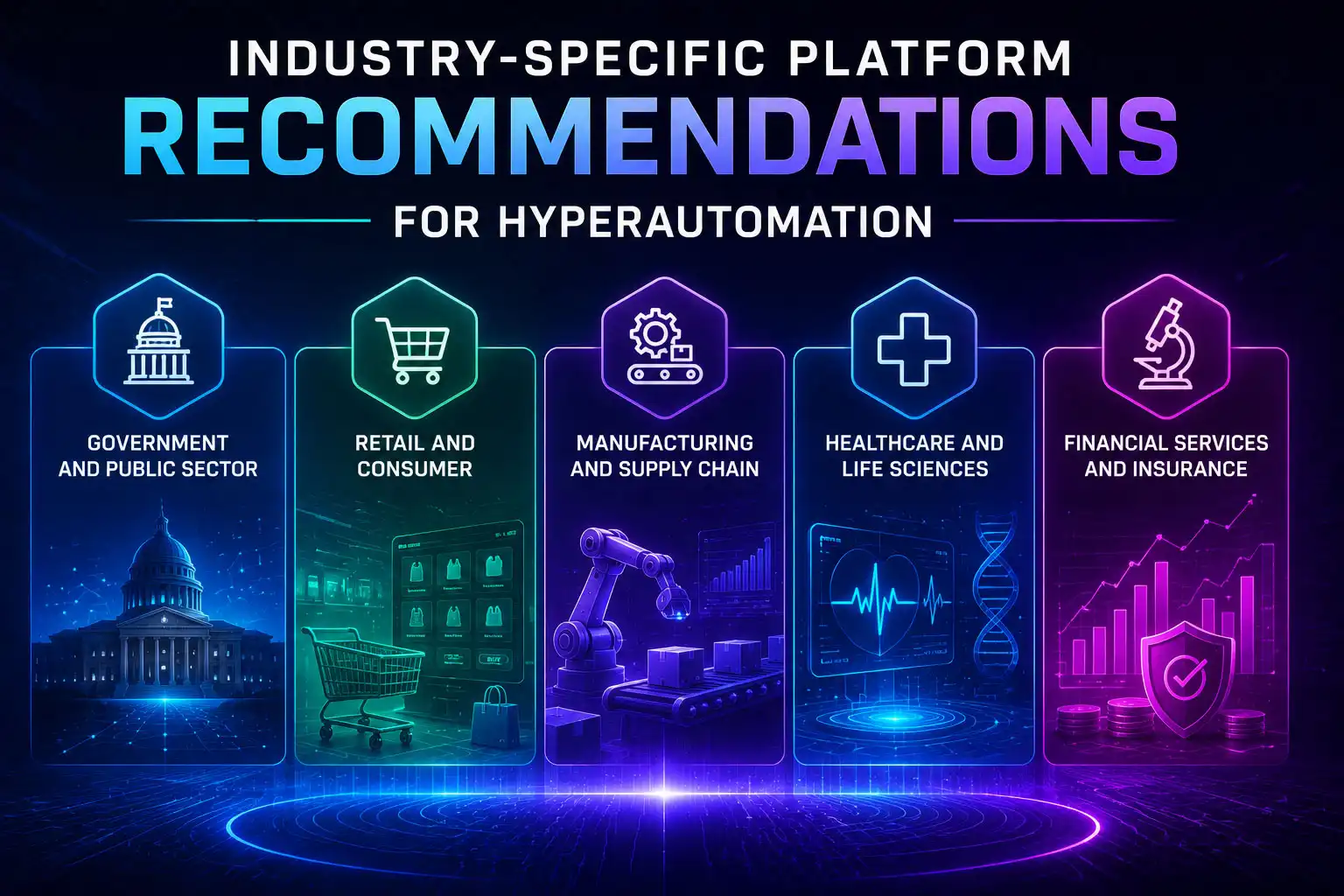
Different industries have different automation priorities — which is why platform selection should always incorporate vertical context alongside general capability assessment.
Financial Services and Insurance: Blue Prism or Automation Anywhere. Compliance architecture, audit trail completeness, and security credentials are essential. UiPath is competitive here but requires more governance configuration investment.
Healthcare and Life Sciences: UiPath or Automation Anywhere, with careful attention to HIPAA compliance configuration and integration with EHR/EMR systems. Intelligent document processing capability is critical for clinical documentation use cases.
Manufacturing and Supply Chain: UiPath or Microsoft Power Automate (for Microsoft-centric environments), with strong consideration of SAP integration depth — most manufacturing automation programs are heavily SAP-dependent.
Retail and Consumer: Microsoft Power Automate for Microsoft-centric retail operations; UiPath for complex omnichannel and supply chain automation. Speed of deployment and citizen developer accessibility tend to outweigh enterprise governance depth in this vertical.
Government and Public Sector: Automation Anywhere (FedRAMP authorized) for U.S. federal requirements; Blue Prism or UiPath for state/local and non-U.S. government.
What Gartner and Forrester Say in 2026
Independent analyst guidance remains a critical input for enterprise platform decisions. As of 2026, the leading analyst positions are consistent with the patterns described above.
Gartner’s Magic Quadrant for Robotic Process Automation continues to position UiPath and Automation Anywhere as Leaders, with Microsoft growing its presence as its Power Platform capabilities mature. Blue Prism maintains a strong position in the Challengers quadrant, reflecting its governance strength against slower innovation pace.
Forrester’s Wave evaluations have similarly highlighted UiPath and Automation Anywhere as the strongest overall platforms, with specific recognition for niche leaders including Pega for intelligent decisioning use cases and ServiceNow for IT-anchored automation programs.
The consistent theme across analyst guidance: platform breadth and AI integration are accelerating as key differentiators. Vendors that cannot demonstrate genuine, production-ready AI capabilities — not just partnerships with external AI services — are losing enterprise evaluations to those that have built AI natively into the automation lifecycle.
Building Your Evaluation Shortlist: A Practical Framework
Given everything above, here is a practical process for arriving at a defensible shortlist of two or three platforms for formal evaluation.
Start with mandatory filters. Define the non-negotiable requirements — compliance certifications, must-have system integrations, deployment architecture constraints (cloud-only, on-premise required, hybrid). Any platform that cannot meet these filters is eliminated regardless of its other capabilities.
Score against weighted criteria. Using the five decision criteria described above plus the capability dimensions in the comparison matrix, define weights appropriate to your organizational context — a highly regulated bank will weight governance more heavily than a technology company; a citizen developer-led program will weight accessibility more heavily than a centrally-governed IT-driven program. Score each shortlisted platform against your weighted criteria.
Require proof of concept on your actual processes. Do not evaluate platforms on demo scenarios. Identify one or two of your highest-priority automation candidates and require each shortlisted vendor to build a working proof of concept on your processes, in your environment, with your data. The gap between platform capability in controlled demos and platform capability on your messy, real-world processes is where platform selection decisions are actually made.
Model total cost of ownership across five years. Year 1 licensing costs are rarely representative of ongoing investment. Model licensing, maintenance, implementation support, training, and infrastructure costs across a five-year horizon for an automation program of the scale you intend to build. This often changes the relative economics significantly — particularly for platforms with complex per-bot or per-process licensing models.
Check references in your vertical. Ask each vendor for three customer references in your industry at approximately your organization size and automation maturity level. Ask those references specifically about implementation challenges, vendor support quality, and whether they would make the same platform choice again.
The Bottom Line
No single hyperautomation platform is best. The right platform is the one that best fits your ecosystem, your team’s capabilities, your compliance requirements, and your program’s strategic objectives.
That said, for most enterprise buyers in 2026, the field narrows quickly. UiPath remains the safest bet for organizations building ambitious, enterprise-wide hyperautomation programs with dedicated automation teams and the budget to support complex implementation. Automation Anywhere is the strongest choice for cloud-native, security-sensitive, and document-heavy deployments. Microsoft Power Automate wins on total cost of ownership and deployment speed for Microsoft-centric organizations. Blue Prism remains the governance benchmark for highly regulated industries.
The decision that will matter more than your platform choice is whether you have the process strategy, governance model, and organizational change management capability to execute your hyperautomation program effectively. The most capable platforms in the world cannot compensate for an automation program without strategic clarity about what it is trying to achieve and how it will measure success.
If you are at the point of platform evaluation, you are close to a significant investment decision. We work with enterprises across industries on hyperautomation strategy, platform selection, and implementation — and we are happy to provide an honest, vendor-neutral assessment of which platform best fits your specific context.
Get in touch with the Bantech team to discuss your hyperautomation requirements and get a recommendation grounded in your actual environment rather than vendor marketing.
Hyperautomation Content Series
Continue the Complete Hyperautomation Guide
This post is a part of the Hyperautomation Content Series — the complete 9 article guide to understanding, implementing, and scaling hyperautomation in your organization.
Hyperautomation is a strategic, multi-technology approach that automates entire end-to-end processes across the enterprise, while RPA is a single technology focused on automating individual rule-based tasks through software bots. The core difference lies in scope, intelligence, and orchestration.
Key Takeaways
- RPA automates repetitive, structured tasks by mimicking human UI interactions.
- Hyperautomation combines RPA with AI, process mining, low-code tools, and orchestration for full process automation.
- RPA works well for isolated high-volume tasks; hyperautomation scales across systems and handles exceptions.
- Organizations often start with RPA and evolve into hyperautomation for greater ROI and governance.
- Choosing correctly depends on process complexity, data types, and long-term transformation goals.
The difference between hyperautomation and RPA is fundamentally one of scope and ambition. Robotic process automation (RPA) uses software bots to replicate human actions on digital interfaces, such as clicking buttons, copying data, or filling forms in structured environments. Hyperautomation, by contrast, is a business-driven strategy that orchestrates multiple technologies including RPA, artificial intelligence, process mining, intelligent document processing, and low-code platforms to automate complete end-to-end workflows across systems and departments. Organizations seeking scalable results often engage partners with deep expertise in enterprise software development to design these integrated architectures correctly from the start.
RPA emerged as a practical solution for high-volume, rule-based work. Bots follow predefined scripts and interact with applications through the user interface when APIs are unavailable. This makes RPA effective for tasks like invoice data entry, report generation, or employee onboarding form completion. However, RPA has clear boundaries. It struggles with unstructured data, changing interfaces, exceptions, and cross-system decision making. Maintenance costs rise quickly when processes evolve, and bots remain siloed within individual departments.
Hyperautomation addresses these limitations by treating automation as an enterprise capability rather than a collection of individual bots. It begins with discovery. Process mining and task mining tools analyze system logs and user behavior to identify high-value automation opportunities objectively. Once opportunities are prioritized, the platform combines RPA for execution, AI and machine learning for classification and prediction, intelligent document processing for unstructured inputs, and orchestration layers to manage handoffs between systems and people. Low-code tools further enable business users to participate in building and refining workflows under proper governance.
A clear way to understand the distinction appears in how each handles a typical accounts payable process. With pure RPA, a bot might extract structured data from a standardized invoice template and enter it into an ERP system. Any deviation such as a scanned handwritten note, an unusual layout, or a missing approval triggers an exception that requires manual intervention. Under a hyperautomation approach, intelligent document processing first extracts data from varied invoice formats, machine learning models flag potential duplicates or anomalies, process orchestration routes exceptions to the right human reviewer with full context, and analytics continuously measure cycle time and exception rates. The entire flow becomes measurable, improvable, and scalable.
This expansion of capability has measurable market impact. Gartner research indicates that organizations adopting hyperautomation practices report significantly higher rates of process improvement and cost reduction compared with those relying solely on standalone RPA deployments. According to Gartner, hyperautomation remains a top strategic technology trend precisely because it moves beyond task automation toward continuous optimization of business operations.
The technology stacks also differ in maturity and governance requirements. RPA platforms focus on bot development, orchestration of attended and unattended robots, and basic credential management. Leading RPA tools deliver strong desktop automation and marketplace components. Hyperautomation platforms add process discovery, AI model management, advanced analytics, compliance reporting, and centralized control rooms that support regulated environments. Capabilities such as role-based access, full audit trails, and change management workflows become non-negotiable when automation spans finance, healthcare, or supply chain operations.
Comparison of RPA and Hyperautomation
| Dimension | RPA | Hyperautomation |
| Primary focus | Individual tasks | End-to-end processes |
| Core technology | Software bots interacting with UIs | RPA + AI/ML + process mining + IDP + orchestration |
| Data handling | Structured and predictable | Structured + unstructured (documents, text, images) |
| Decision making | Rule-based only | Rules plus machine learning and confidence scoring |
| Discovery method | Interviews and workshops | Process and task mining on system logs |
| Exception management | Manual handoff | Automated routing with human-in-the-loop |
| Scalability | Departmental, limited | Enterprise-wide with centralized governance |
| Typical ROI timeline | 3–9 months for individual processes | 8–18 months for full programs |
| Governance requirements | Basic bot management | Full audit trails, compliance controls, CoE support |
Organizations evaluating the shift should examine three practical dimensions. First, process complexity: if work involves mostly structured data and stable interfaces, RPA may deliver quick wins. Second, data variety: when documents, emails, and free-text inputs dominate, AI-enhanced hyperautomation becomes essential. Third, scale and governance: enterprises aiming for cross-departmental programs with measurable ROI and auditability need the broader platform approach. Many successful programs begin with targeted RPA projects to prove value, then expand into hyperautomation once governance and skills mature. A detailed comparison of leading platforms appears in our best hyperautomation platforms compared 2026 analysis, which evaluates deployment models, AI maturity, and total cost of ownership.
Ready to move beyond isolated bots?
If your organization has already deployed RPA and is hitting limits around exceptions, unstructured data, or cross-system orchestration, the next step is a structured assessment of where hyperautomation can deliver higher returns. Our team helps enterprises map current processes, identify high-impact opportunities, and design governed solutions that combine the right mix of technologies. Request a quote to discuss your specific requirements and receive a practical roadmap.
Implementation success depends on more than technology selection. Teams need clear ownership, often through a Center of Excellence that balances IT control with business participation. Skills requirements expand from bot developers to include process analysts, data scientists, and citizen developers supported by low-code tools. Change management becomes critical because hyperautomation alters roles and requires continuous monitoring of bot performance and model drift.
Common pitfalls include treating hyperautomation as simply “RPA plus AI” without addressing process discovery or governance. Another frequent mistake is underestimating integration complexity with legacy systems. Organizations that invest in proper architecture and measurement frameworks avoid these issues and achieve sustained value. Our hyperautomation complete guide explores the full technology stack and strategic roadmap in greater detail.
When RPA remains the right choice, the decision is usually tactical. High-volume, stable, rule-based processes with clear boundaries deliver fast payback and require limited organizational change. When the goal is enterprise transformation, reduced operational risk, and continuous process improvement, hyperautomation provides the necessary foundation. The two approaches are complementary rather than mutually exclusive. RPA serves as the execution layer inside a larger hyperautomation strategy.
Selecting the correct path requires honest assessment of current maturity, data landscape, and strategic priorities. Organizations that treat automation as a long-term capability rather than a series of short-term projects consistently outperform those that deploy tools in isolation. The difference between hyperautomation and RPA ultimately determines whether automation remains a departmental efficiency tool or becomes a competitive advantage across the enterprise.
Build automation that actually scales.
Contact Bantech today to evaluate your processes, map a practical roadmap, and implement the right combination of RPA and hyperautomation capabilities for your organization. Get in touch and start turning operational complexity into measurable performance.
The best hyperautomation platforms in 2026 are UiPath, Automation Anywhere, Microsoft Power Automate, SS&C Blue Prism and ServiceNow Automation Engine. Each leads in different areas such as AI maturity, cloud architecture, Microsoft ecosystem fit, regulatory governance or ITSM integration, so the right choice depends on organizational context rather than a single ranking.
Key Takeaways
- UiPath leads for complex, high-volume enterprise programs with strong AI and process mining.
- Automation Anywhere excels in cloud-native deployments and document-heavy workflows.
- Microsoft Power Automate offers the lowest barrier and deepest Microsoft 365 integration.
- Blue Prism remains the strongest option for highly regulated industries needing rigorous audit controls.
- Platform selection should prioritize fit with existing systems, governance needs and total cost of ownership over feature checklists.
The best hyperautomation platforms in 2026 combine robotic process automation, artificial intelligence, process mining, intelligent document processing and low-code development into governed environments that scale across the enterprise. No single platform dominates every dimension. Buyers must match capabilities to their architecture, compliance requirements and desired speed of adoption. Organizations building these capabilities frequently partner with specialists in artificial intelligence services to ensure models, orchestration and governance work together effectively.
UiPath continues to set the standard for mature, large-scale programs. Its process mining depth, AI Center for model management and extensive marketplace of pre-built components reduce development time for complex, multi-system workflows. Generative AI features now allow developers to describe automations in natural language and generate underlying code. The trade-off is higher total cost of ownership and greater complexity. Enterprises without experienced automation teams or strong implementation partners often face longer ramp-up periods. Typical ROI appears in 12 to 18 months for full deployments, though early high-volume processes can pay back sooner.
Automation Anywhere positions itself as the cloud-native alternative. Its AA360 platform was built for cloud-first operation, delivering strong scalability and transparent subscription pricing relative to traditional licensing models. Document Automation ranks among the strongest offerings for semi-structured documents such as contracts, invoices and insurance forms. Security credentials, including FedRAMP authorization, make it suitable for U.S. federal and highly regulated workloads. The partner ecosystem and process mining capabilities remain smaller than UiPath’s, so organizations with extensive custom integration needs may require more development effort.
Microsoft Power Automate, paired with Azure AI and Copilot Studio, has become the default choice for Microsoft-centric organizations. Native integration with Microsoft 365, Teams, SharePoint and Dynamics creates immediate automation opportunities that pure RPA platforms struggle to match. Licensing often leverages existing Enterprise Agreements, producing lower entry costs. Citizen developers can build workflows using natural language prompts, accelerating adoption. Limitations appear in complex desktop automation, mainframe environments and large unattended bot fleets. Organizations whose critical processes live outside the Microsoft ecosystem frequently supplement Power Automate with a dedicated RPA platform for those use cases.
SS&C Blue Prism focuses on governance and auditability. Following its acquisition, the platform has doubled down on the control room architecture that regulated industries value. Every bot action is logged, process changes are fully tracked and the design philosophy makes it difficult to create automations that operate outside approved controls. This strength is also its constraint. Citizen developer support is limited and the platform requires meaningful technical expertise. ROI timelines are typically longer, often 14 to 24 months, reflecting the heavier implementation and governance overhead.
ServiceNow Automation Engine extends the platform’s ITSM and workflow strengths into broader hyperautomation. For organizations already running ServiceNow as their operational backbone, the IntegrationHub, RPA Hub and Now Intelligence layer create a unified environment that connects IT service management with business process automation. Low-code tools allow business developers to extend existing workflows. The platform is less effective when large portions of the automation target live entirely outside ServiceNow, such as manufacturing systems or complex legacy financial applications.
Platform Comparison Overview
| Platform | Best For | Key Strength | Primary Limitation | Typical ROI Timeline |
| UiPath | Large complex programs | AI maturity and process mining | Highest cost and complexity | 12–18 months |
| Automation Anywhere | Cloud-first, document-heavy work | Cloud architecture and IDP | Smaller marketplace and mining depth | 10–16 months |
| Microsoft Power Automate | Microsoft ecosystem organizations | Integration and low entry cost | Limited complex desktop RPA | 8–14 months |
| SS&C Blue Prism | Regulated industries | Governance and audit controls | Weak citizen developer support | 14–24 months |
| ServiceNow Automation Engine | ServiceNow-centric environments | ITSM and workflow unification | Narrower reach outside ServiceNow | 8–14 months |
Market context reinforces the need for careful selection. The hyperautomation market reached approximately USD 68 billion in 2026 and continues rapid expansion. Analysts consistently place UiPath and Automation Anywhere at the top of pure-play evaluations while recognizing Microsoft’s rising position through ecosystem advantages. Real-world results still depend more on organizational fit than on analyst rankings. Practical examples of how these platforms perform across industries appear in our hyperautomation examples by industry overview.
Choosing the right platform for your context
If your organization already runs a significant Microsoft footprint and needs rapid, lower-cost automation for standard processes, Power Automate is usually the practical starting point. For high-volume, multi-system programs that demand deep AI and process intelligence, UiPath remains the most complete option. Cloud-native teams focused on document processing often find Automation Anywhere the better architectural match. Regulated industries that treat auditability as non-negotiable continue to select Blue Prism. ServiceNow customers gain the most by extending their existing platform rather than introducing a separate automation stack.
Beyond feature lists, buyers should evaluate three additional factors. Total cost of ownership includes licensing, implementation partners, infrastructure and ongoing maintenance. Talent availability matters because platforms with larger developer communities reduce hiring and training friction. Governance maturity determines whether the platform can support a Center of Excellence and satisfy compliance teams. Organizations that skip these considerations frequently experience cost overruns or stalled programs.
Ready to select and implement the right platform?
Choosing among the best hyperautomation platforms in 2026 requires a clear view of your current systems, priority processes and risk tolerance. Our team works with enterprises to assess readiness, shortlist suitable platforms and design implementation roadmaps that balance speed with governance. Request a quote to begin a structured evaluation tailored to your environment.
Successful deployments also depend on strategy. Technology alone does not deliver results. Organizations need defined ownership, prioritization frameworks based on process mining data, and continuous measurement of ROI and exception rates. A practical framework for building that foundation is outlined in our how to build a hyperautomation strategy guide.
The landscape will continue to evolve as generative AI and agentic capabilities mature. Platforms that invest heavily in natural language development, model governance and seamless human-in-the-loop experiences will extend their leads. For most enterprises in 2026, the winning approach is not chasing the highest-ranked tool but selecting the platform that aligns with existing investments and can scale under proper controls.
Turn platform selection into measurable results.
Contact Bantech to evaluate your automation opportunities, compare the leading platforms against your specific requirements and implement a solution that delivers lasting operational impact. Get in touch and move from evaluation to execution with confidence.
UiPath is better for large, complex enterprise programs that need deep AI, process mining and robust orchestration. Automation Anywhere is better for cloud-native organizations focused on document automation and security. Microsoft Power Automate is better for Microsoft-centric teams that want rapid deployment and lower total cost of ownership. The right choice depends on existing systems, process complexity and governance needs rather than a universal winner.
Key Takeaways
- UiPath leads in feature depth, AI maturity and large-scale bot management.
- Automation Anywhere stands out for cloud-native architecture and strong intelligent document processing.
- Power Automate wins on cost, ease of adoption and seamless Microsoft 365 integration.
- Pure feature rankings matter less than fit with your technology stack and compliance requirements.
- Many organizations successfully run a hybrid model, using Power Automate for simpler flows and a dedicated platform for complex unattended work.
UiPath, Automation Anywhere and Microsoft Power Automate represent the three most frequently evaluated options for enterprise automation in 2026. Each has matured beyond basic robotic process automation into broader hyperautomation capabilities, yet they differ sharply in architecture, cost structure, AI integration and ideal buyer profile. Organizations implementing these platforms often require specialized support through custom software development to handle complex integrations, custom connectors and governance layers that out-of-the-box features cannot fully address.
UiPath remains the most complete pure-play platform for complex, high-volume automation programs. Its process mining capabilities, AI Center for governed machine learning models and large marketplace of pre-built components give it an edge in multi-system environments. Generative AI features allow developers to describe processes in natural language and generate workflow code, reducing development time. The platform supports both attended and unattended bots at scale with mature orchestration, credential management and analytics. The primary drawbacks are cost and complexity. Licensing is among the highest in the market and organizations without experienced automation teams or strong implementation partners frequently encounter longer learning curves and higher maintenance overhead. Typical positive ROI for full enterprise deployments falls in the 12 to 18 month range.
Automation Anywhere differentiates through its cloud-native foundation. The AA360 platform was designed for cloud-first operation, delivering advantages in deployment speed, elasticity and centralized management. Its Document Automation stack ranks among the strongest for handling semi-structured and complex documents such as contracts, purchase orders and insurance forms. Security posture is enterprise-grade, with FedRAMP authorization making it one of the few platforms suitable for U.S. federal workloads. Attended automation through AARI provides a polished human-in-the-loop experience. Limitations include a smaller partner ecosystem and process mining depth that trails UiPath. Pricing is generally more transparent than UiPath’s enterprise deals, with mid-market deployments often falling in a more predictable subscription range.
Microsoft Power Automate, combined with Azure AI Services and Copilot Studio, has become the practical default for organizations already invested in the Microsoft ecosystem. Native connectors for Microsoft 365, Teams, SharePoint, Dynamics and Azure services create automation opportunities that dedicated RPA tools cannot match in speed or cost. Licensing is frequently included or heavily discounted under existing Microsoft Enterprise Agreements, producing the lowest total cost of ownership for many buyers. Citizen developers can build flows using natural language, accelerating adoption across business units. The platform’s desktop RPA capabilities have improved but still lag UiPath and Automation Anywhere in complex legacy system automation, mainframe interactions and large-scale unattended bot fleets. Organizations with significant non-Microsoft systems often reach a ceiling and add a dedicated platform for those workloads.
Side-by-side comparison
| Criterion | UiPath | Automation Anywhere | Microsoft Power Automate |
| Best overall fit | Complex enterprise programs | Cloud-first, document-heavy work | Microsoft-centric organizations |
| AI and document processing | Very strong (AI Center + DU) | Excellent (Document Automation) | Strong via Azure AI and AI Builder |
| Cloud architecture | Hybrid / cloud options | Native cloud-first | Fully cloud (Microsoft infrastructure) |
| Desktop / legacy RPA strength | Highest | High | Moderate |
| Ease of entry / citizen development | Moderate | Moderate to high | Highest |
| Governance and scale | Excellent | Strong | Improving but lighter |
| Typical entry cost | Highest | Moderate | Lowest |
| ROI timeline (full program) | 12–18 months | 10–16 months | 8–14 months |
Market data supports these distinctions. Analyst evaluations consistently place UiPath and Automation Anywhere as leaders in pure RPA and hyperautomation capability, while Microsoft gains ground through ecosystem reach and rapid feature velocity. Real deployments show that total cost of ownership, existing skill sets and process characteristics often outweigh pure feature scores. Deeper insight into the underlying technologies that power these platforms appears in our core technologies powering hyperautomation in 2026 analysis.
Decision frameworks that work in practice start with three questions. First, how heavily does the organization already rely on Microsoft 365 and Azure? Heavy reliance tilts strongly toward Power Automate for the majority of use cases. Second, what percentage of target processes involve complex desktop automation, mainframes or highly variable documents? Higher percentages favor UiPath or Automation Anywhere. Third, what level of centralized governance and auditability is required? Regulated industries and large Centers of Excellence usually prefer the deeper control rooms available in the pure-play platforms.
Many enterprises ultimately adopt a hybrid approach. Power Automate handles high-volume, Microsoft-centric and citizen-developer flows, while UiPath or Automation Anywhere manages complex unattended bots and document-intensive processes. This combination often produces better overall economics than forcing every use case onto a single platform.
Need help deciding which platform fits your environment?
Selecting between UiPath, Automation Anywhere and Microsoft Power Automate requires a clear inventory of your current systems, priority processes and risk profile. Our team conducts structured assessments that map these factors against platform strengths and produce a practical recommendation with implementation considerations. Request a quote to start an objective evaluation tailored to your organization.
Beyond the initial choice, success depends on process discovery, prioritization and ongoing measurement. Platforms deliver the highest returns when paired with process mining to identify opportunities objectively and with governance structures that prevent bot sprawl. Organizations that treat the decision as purely technical frequently underperform those that align technology with operating model and skills. Additional guidance on building the surrounding strategy can be found in related resources on process architecture and automation centers of excellence.
In 2026 the three platforms continue to converge on generative AI and agentic capabilities, yet the core architectural differences remain. UiPath offers the deepest enterprise feature set, Automation Anywhere the cleanest cloud experience and strongest document focus, and Power Automate the most accessible and cost-effective entry for Microsoft environments. The better platform is the one that matches your specific constraints and growth plans.
Move from comparison to confident selection.
Contact Bantech to evaluate your automation landscape, compare these three platforms against real process data and implement the solution that delivers the strongest return. Get in touch and turn platform evaluation into measurable operational improvement.
UiPath typically carries the highest total cost of ownership, with mid-scale enterprise licensing starting around $48,000 per year and rising significantly with bots and AI features. Automation Anywhere offers more transparent cloud subscriptions often in the 35,000–80,000 range for mid-market. Microsoft Power Automate is the lowest-cost option, frequently starting at $15 per user per month or included in existing Microsoft licenses. Blue Prism enterprise deployments generally fall between $60,000 and $120,000 or more annually. True TCO always includes implementation, maintenance, infrastructure and governance costs beyond the license price.
Key Takeaways
- License price is only one part of total cost of ownership; implementation, people and ongoing operations often exceed it.
- UiPath has the highest sticker price and complexity-driven costs.
- Power Automate usually delivers the lowest TCO for Microsoft-centric organizations.
- Automation Anywhere balances cloud predictability with solid mid-market pricing.
- Blue Prism costs reflect its governance focus and are highest in regulated environments.
- Always model three-year TCO rather than year-one license fees alone.
Understanding the pricing and total cost of ownership of leading hyperautomation platforms requires looking past published list prices. Vendors structure deals differently, discount heavily at enterprise scale, and generate substantial additional costs through implementation partners, infrastructure, training and continuous maintenance. Organizations that focus only on the license frequently underestimate the real investment required. Teams responsible for these programs often need support in areas such as security and compliance to ensure governance controls do not inflate long-term operating costs.
UiPath commands the highest pricing in most configurations. Enterprise licensing for mid-scale deployments starts at approximately $48,000 per year and scales upward with bot count, process complexity and AI feature usage. Actual spend frequently exceeds initial projections as organizations add unattended bots, Document Understanding capacity and AI Center resources. The platform’s depth drives higher implementation and maintenance effort. Organizations without internal expertise rely on partners, adding professional services costs that can equal or exceed the first-year license. Typical full-program ROI appears in 12 to 18 months, but only when high-volume processes are prioritized early. Negotiated enterprise agreements remain highly flexible, so list prices should be treated as starting points rather than final figures.
Automation Anywhere generally presents more transparent cloud subscription pricing. Mid-market deployments commonly range from $35,000 to $80,000 annually, with enterprise contracts negotiated per volume and features. The cloud-native architecture reduces some infrastructure overhead compared with hybrid or on-premises alternatives. Document Automation and AARI capabilities are included in higher tiers, so buyers should clarify what is bundled versus add-on. Partner ecosystem costs tend to be lower than UiPath for standard implementations, though complex integrations still require external help. ROI timelines of 10 to 16 months are realistic for document-heavy use cases that leverage the platform’s strengths.
Microsoft Power Automate offers the most favorable entry economics for many organizations. Premium features start at approximately $15 per user per month, while certain capabilities are included with Microsoft 365 E3 or E5 licenses or Dynamics agreements. Process and unattended RPA capacity is priced separately, often around $150 per bot per month in published ranges, yet large enterprises frequently absorb these costs inside broader Microsoft contracts. The low license barrier is offset by potential limits in complex legacy automation, which can force supplemental platforms and raise overall TCO. When processes stay inside the Microsoft ecosystem, total cost of ownership is typically the lowest of the four platforms and ROI can appear in 8 to 14 months.
SS&C Blue Prism pricing is the least transparent of the group. Public figures are limited; meaningful enterprise deployments commonly fall in the $60,000 to $120,000-plus annual range depending on digital worker count and modules. The platform’s governance architecture and control room capabilities justify higher costs for regulated industries, yet they also increase implementation complexity and the need for specialized skills. Longer ROI horizons of 14 to 24 months are common. Organizations in banking, insurance or pharmaceuticals often accept the premium because auditability and compliance controls reduce risk-related costs elsewhere.
Approximate Pricing and TCO Indicators (2026)
| Platform | Typical Mid-Scale Annual License | Key Cost Drivers | Relative TCO Rank | Notes on Hidden Costs |
| UiPath | From ~$48,000 | Bots, AI features, complexity | Highest | Partner services, training, maintenance |
| Automation Anywhere | 35,000–80,000 | Subscription volume, document capacity | Moderate–High | Custom integrations, partner support |
| Microsoft Power Automate | From $15/user/month (or bundled) | Premium connectors, unattended bots | Lowest | Supplemental platforms for complex work |
| SS&C Blue Prism | 60,000–120,000+ | Digital workers, governance modules | High | Specialized skills, longer implementation |
These figures represent starting or typical ranges only. Final pricing is almost always negotiated and influenced by volume commitments, multi-year terms and competitive pressure. More important than the license is the full three-year total cost of ownership model. That model must include implementation and change management, infrastructure or cloud consumption, ongoing bot maintenance and exception handling, Center of Excellence staffing, training and certification, and opportunity cost when processes remain manual longer than necessary.
Industry observations show that organizations which underestimate people and process costs often see actual TCO 1.5 to 2.5 times the initial license projection. Platforms with steeper learning curves or heavier governance requirements amplify this effect. Conversely, platforms that leverage existing skills and licenses, such as Power Automate inside a Microsoft estate, keep the multiplier closer to 1.2 to 1.5.
Need a realistic TCO model for your environment?
License comparisons alone rarely reveal the true investment. Factors such as existing Microsoft footprint, volume of unstructured documents, legacy system density and internal automation maturity change the ranking of these platforms dramatically. Our team builds customized three-year TCO models that incorporate your process mix, current systems and governance requirements so you can compare options on equal footing. Request a quote to receive a structured cost assessment.
Beyond pure cost, buyers should weigh risk-adjusted value. A higher-priced platform that reduces compliance exposure or accelerates high-volume process automation can deliver superior net returns. Conversely, the lowest license cost becomes expensive if it forces parallel tools or leaves complex processes unaddressed. Practical guidance on aligning platform economics with overall automation strategy is available in resources covering process prioritization and operating model design.
In 2026 the pricing landscape continues to favor flexible cloud subscriptions and bundled ecosystem deals. UiPath remains the premium option for depth, Automation Anywhere the balanced cloud choice, Power Automate the cost leader for Microsoft environments, and Blue Prism the governance premium play. Organizations that model total cost of ownership honestly, negotiate from a position of process clarity, and account for people and process costs make better long-term decisions than those that chase the lowest sticker price.
Make pricing decisions with full visibility.
Contact Bantech to map your current automation spend, build an accurate total cost of ownership comparison across these platforms, and identify the option that delivers the strongest return for your scale and complexity. Get in touch and turn cost uncertainty into a clear investment case.
UiPath is the best hyperautomation platform for most large enterprises and complex organizations in 2026 because of its superior process mining, AI maturity, orchestration at scale and extensive ecosystem. Alternatives such as Automation Anywhere suit cloud-first global enterprises, while SS&C Blue Prism remains preferred for heavily regulated environments that prioritize auditability above all else.
Key Takeaways
- UiPath leads for large enterprises needing deep AI, process discovery and high-volume bot fleets.
- Automation Anywhere is strong for cloud-native global operations with heavy document processing.
- Blue Prism is the preferred choice when regulatory compliance and centralized governance are non-negotiable.
- Microsoft Power Automate works well as a complementary layer inside Microsoft-heavy enterprises but rarely as the sole platform for complex scale.
- Success at enterprise scale depends as much on Center of Excellence maturity and process prioritization as on the platform itself.
Large enterprises evaluating hyperautomation face a different set of constraints than mid-market organizations. Volume, legacy system complexity, multi-region operations, strict compliance requirements and the need for centralized governance all raise the bar. The platform that wins is the one that can manage hundreds or thousands of bots, integrate with decades-old systems, support process mining at scale and provide audit-ready controls without constant custom work. Organizations undertaking this level of transformation frequently require partners experienced in transforming legacy systems so that older applications can participate reliably in modern automated workflows.
UiPath currently holds the strongest overall position for large, complex enterprises. Its process mining capabilities, originally strengthened through the Process Gold acquisition, allow organizations to discover automation opportunities from real system logs rather than relying solely on interviews. The AI Center provides governed deployment and monitoring of machine learning models inside automation workflows, a critical requirement when models must meet internal risk and compliance standards. The marketplace ecosystem is the largest in the industry, reducing development time for common enterprise processes. Orchestration, credential management and analytics are mature enough to support global Centers of Excellence. The platform’s main drawbacks remain cost and complexity. Licensing is the highest among major vendors and organizations without experienced teams or implementation partners experience longer ramp-up periods. For enterprises that can absorb the investment, typical full-program ROI falls in the 12 to 18 month window, with individual high-volume processes often delivering returns earlier.
Automation Anywhere is the strongest alternative for large enterprises that prioritize cloud-native architecture and document-intensive processes. Its AA360 platform was built cloud-first, delivering advantages in scalability, global deployment and management consistency. Document Automation ranks among the most capable solutions for complex, semi-structured documents common in finance, insurance and shared services. Security credentials, including FedRAMP, make it suitable for government and highly regulated workloads. The platform’s attended automation experience is polished and well suited to customer-facing or human-in-the-loop scenarios. Limitations include a smaller pre-built component marketplace and process mining depth that still trails UiPath. Enterprises with extensive custom integration needs should plan for additional development effort.
SS&C Blue Prism remains the platform of choice for large organizations in banking, insurance, healthcare, pharmaceuticals and other regulated sectors where auditability is paramount. Its control room and governance architecture set the industry standard. Every action is logged, process changes are fully tracked and the platform design makes it difficult to create automations that bypass approved controls. Intelligent automation capabilities have been strengthened through acquisitions and the Chorus decision management layer. The trade-off is reduced agility. Citizen developer support is limited and development typically requires experienced technical resources. Implementation complexity leads to longer ROI timelines, often 14 to 24 months for full programs.
Microsoft Power Automate plays an important supporting role inside large Microsoft-centric enterprises but is rarely the primary platform for the most complex, high-volume workloads. Its unmatched integration with Microsoft 365, Dynamics and Azure creates rapid value for standard processes and citizen development. Licensing advantages through existing Enterprise Agreements keep costs low. However, desktop RPA maturity, mainframe support and large-scale unattended orchestration still lag the pure-play leaders. Many large organizations therefore run Power Automate for Microsoft-centric and departmental flows while relying on UiPath or Automation Anywhere for the core enterprise automation estate.
Enterprise Platform Fit Summary
| Platform | Ideal Enterprise Profile | Scale Strengths | Key Constraints |
| UiPath | Complex multi-system, high-volume programs | Process mining, AI governance, ecosystem | Highest cost, steeper learning curve |
| Automation Anywhere | Cloud-first global operations, document heavy | Cloud architecture, IDP, security | Smaller marketplace, lighter mining |
| SS&C Blue Prism | Heavily regulated industries | Audit trails, control room, compliance | Limited citizen development, slower pace |
| Microsoft Power Automate | Microsoft-heavy enterprises (complementary) | Cost, integration, rapid adoption | Limited complex legacy and scale depth |
Analyst consensus and real-world deployments reinforce these patterns. Enterprises that treat platform selection as a pure feature contest frequently overspend or under-deliver. Those that start with process discovery, define clear governance models and align platform strengths to their dominant system landscape achieve more consistent results. A practical view of how the underlying technologies interact at enterprise scale is covered in related technical resources on architecture and process intelligence.
Is your enterprise ready to scale automation beyond departmental pilots?
Large organizations often discover that the limiting factor is not platform features but the ability to prioritize processes objectively, integrate legacy systems cleanly and maintain governance as the bot estate grows. Our team helps enterprises assess readiness, shortlist the platforms best suited to their scale and compliance profile, and design implementation approaches that protect long-term ROI. Request a quote to begin a structured evaluation.
Beyond the initial platform decision, sustained success requires an operating model. A functioning Center of Excellence, clear ownership of process prioritization, continuous monitoring of bot performance and exception rates, and ongoing skills development are essential. Organizations that invest only in technology while neglecting these elements see diminishing returns after the first wave of automations. Further guidance on moving from tactical RPA deployments to governed enterprise programs can be found in our discussion of the difference between RPA and hyperautomation.
In 2026 the best hyperautomation platform for large enterprises is the one that can absorb complexity, enforce governance and continue delivering measurable value as the automation footprint expands. For most complex, multi-system organizations that platform is UiPath. For cloud-native global enterprises it is often Automation Anywhere. For the most tightly regulated environments it remains Blue Prism. Matching the platform to the enterprise reality, rather than to marketing claims, is what separates successful programs from expensive experiments.
Scale automation with confidence.
Contact Bantech to evaluate your enterprise processes, compare the leading platforms against your specific scale and compliance requirements, and implement a solution built for long-term performance. Get in touch and turn enterprise complexity into a competitive advantage.
Choose the right hyperautomation platform by matching it to your existing technology stack, process complexity, governance requirements, AI needs and total cost of ownership rather than chasing the highest-ranked tool. Start with an honest assessment of your systems and priority processes, then evaluate platforms on deployment architecture, integration breadth, AI maturity, citizen development support and long-term ROI potential. Fit consistently outperforms pure feature lists.
Key Takeaways
- Begin with process discovery and a clear inventory of your current systems and constraints.
- Prioritize organizational fit over analyst rankings or marketing claims.
- Evaluate five core dimensions: architecture, AI and document capabilities, integration, governance and total cost of ownership.
- Run a structured proof of concept on real high-value processes before committing.
- Plan for the operating model and Center of Excellence alongside the technology decision.
Selecting the right hyperautomation platform is one of the highest-leverage technology decisions an organization can make. The wrong choice locks in higher costs, slower adoption and limited scale. The right choice becomes a durable operational advantage. The process starts with clarity about your own environment rather than vendor demos. Organizations that need external capacity to run this assessment and subsequent implementation frequently turn to a dedicated software development team that can combine process analysis with technical evaluation.
Begin by documenting three foundational inputs. First, map your dominant technology landscape. Heavy reliance on Microsoft 365, Dynamics and Azure strongly favors Power Automate for a large share of use cases. Significant ServiceNow footprint points toward extending that platform. Heterogeneous environments with substantial legacy desktop or mainframe applications usually require a pure-play leader such as UiPath or Automation Anywhere. Second, classify your target processes by volume, data type and exception rate. High volumes of semi-structured documents elevate the importance of intelligent document processing strength. Stable, rule-based desktop work places greater weight on mature unattended RPA. Third, define non-negotiable governance and compliance requirements. Regulated industries often need the audit depth that Blue Prism or UiPath provide.
With those inputs clear, evaluate platforms across five practical dimensions. Deployment architecture matters because it affects speed, scalability and operational overhead. Cloud-native platforms simplify global management and elastic capacity. Hybrid or on-premises options remain relevant for data residency or air-gapped environments. AI maturity and document processing capability determine how much unstructured work the platform can absorb without constant human intervention. Integration breadth covers both pre-built connectors and the ease of building custom ones to core systems of record. Governance and compliance controls include role-based access, full audit trails, credential vaulting, change management and model monitoring for AI components. Finally, model total cost of ownership over three years, including licenses, implementation, infrastructure, maintenance, training and Center of Excellence staffing.
A structured comparison against these dimensions quickly narrows the field. UiPath typically leads when process mining depth, AI governance and large-scale orchestration are critical. Automation Anywhere scores highest for cloud-first organizations with heavy document workloads and strong security requirements. Microsoft Power Automate wins on cost and speed when the Microsoft ecosystem already dominates daily work. Blue Prism remains the default for environments where auditability and centralized control outweigh agility. ServiceNow Automation Engine is rarely the primary platform unless ServiceNow already serves as the operational backbone.
Practical Selection Checklist
- Inventory existing systems and quantify Microsoft, ServiceNow or legacy density.
- Prioritize 5–10 high-value processes using volume, cost and exception data.
- Score shortlisted platforms on architecture, AI/IDP, integration, governance and three-year TCO.
- Require a proof of concept on at least two real processes, including exception handling.
- Assess talent availability and partner ecosystem strength in your region.
- Define the operating model and Center of Excellence structure before final contract.
- Negotiate commercial terms only after the technical and process fit is proven.
Proof of concept design is often the difference between a confident decision and an expensive regret. Select processes that represent both the happy path and the realistic exception volume. Measure not only development speed but also exception rates, rework effort and the ease of adding human-in-the-loop steps. Involve both IT and business stakeholders so adoption realities surface early. Platforms that look strong in demos sometimes reveal friction when real data and real users enter the picture.
Commercial negotiations should follow technical validation, not precede it. Enterprise deals for UiPath, Automation Anywhere and Blue Prism remain highly flexible. Microsoft pricing is more standardized yet still influenced by overall Enterprise Agreement leverage. Insist on clarity around what is included versus add-on, especially AI capacity, document processing pages and unattended bot hours. Build the three-year TCO model with realistic assumptions about growth in bot count and process coverage.
Ready to structure an objective platform evaluation?
Most organizations benefit from an outside view that combines process mining insights with platform knowledge and commercial benchmarking. Our team helps enterprises complete the assessment framework, design meaningful proofs of concept and produce a clear recommendation tied to measurable business outcomes. Request a quote to begin a decision process grounded in your actual environment rather than vendor marketing.
The final and frequently overlooked factor is the operating model. Technology selection without ownership, prioritization rules and continuous measurement produces bot sprawl and declining returns. Establish a Center of Excellence with clear mandates for process intake, development standards, production support and ROI tracking. Align incentives so business units surface opportunities rather than protect manual work. Platforms deliver their highest value only when the surrounding processes and people are designed to support them. Additional detail on building that foundation appears in resources covering hyperautomation strategy and process architecture.
In 2026 the organizations that choose well treat platform selection as a matching exercise rather than a ranking contest. They start with their own systems and processes, evaluate the five core dimensions rigorously, validate through real proofs of concept and design the operating model in parallel. That disciplined approach consistently produces better long-term outcomes than selecting the tool with the most impressive feature list or the strongest analyst report.
Select with confidence and implement with clarity.
Contact Bantech to run a structured evaluation of your processes and systems, shortlist the platforms that fit, and move from decision to a governed implementation roadmap. Get in touch and turn platform choice into sustained operational advantage.
A true hyperautomation platform integrates process and task discovery, robotic process automation, native AI and machine learning, low-code development, analytics with continuous improvement, and enterprise-grade governance in a single governed environment. An RPA tool primarily executes rule-based bots and may offer limited add-ons, but it lacks the full set of integrated capabilities required for end-to-end, scalable automation. The distinction is one of scope, intelligence and orchestration rather than marketing labels.
Key Takeaways
- RPA tools automate individual tasks; true platforms automate and optimize entire processes.
- Six capabilities must be present and integrated: discovery, RPA, AI/ML, low-code, analytics and governance.
- Platforms that rely mainly on third-party connectors for AI or lack process mining fall short of true hyperautomation.
- Governance and continuous improvement separate enterprise platforms from departmental bot tools.
- Evaluating against these six criteria protects buyers from overpaying for expanded RPA dressed as hyperautomation.
The market is crowded with vendors that expand an RPA product and rebrand it as a hyperautomation platform. The practical test is whether the offering delivers a complete, integrated set of capabilities that allow an organization to discover, build, run, measure and govern automation at enterprise scale. Organizations that need help applying this test and designing the surrounding architecture often engage specialists in product design and ideation to map requirements before technology selection begins.
A true hyperautomation platform must provide process and task discovery. This means the ability to analyze system event logs and user behavior to identify and prioritize automation opportunities objectively. Relying solely on stakeholder interviews produces biased and incomplete backlogs. Process mining and task mining surface the real paths, variants and bottlenecks so that investment targets the highest-value work.
It must include mature robotic process automation for both attended and unattended execution across desktop and web environments. A robust orchestration layer is required to schedule, manage and scale bot fleets, handle credentials securely and recover from failures. Basic RPA bots without enterprise orchestration remain departmental tools.
Native AI and machine learning integration is non-negotiable. The platform should support natural language processing, intelligent document processing, computer vision and decision intelligence inside its own environment, not merely through loose connectors to external services. Model deployment, monitoring and governance must sit alongside bot governance so that AI components remain controllable and auditable.
Low-code and no-code process development tools are essential for scale. Business users and citizen developers need visual workflow builders, pre-built connectors and reusable component libraries so that automation capacity is not limited by the size of the IT or specialist team. Platforms that keep development locked inside highly technical environments cannot expand beyond a small number of processes.
Analytics and continuous improvement close the loop. Dashboards, ROI tracking, process conformance monitoring and bot performance analytics provide ongoing visibility into value delivered and surface new optimization opportunities. Without this layer, automation programs stagnate after the first wave of bots.
Finally, governance, security and compliance controls must be built in. Role-based access, complete audit trails, credential vaulting, change management workflows and compliance reporting are required for regulated industries and for any organization that intends to operate automation as a controlled enterprise capability rather than a collection of unsupervised scripts.
Six Capabilities That Define a True Hyperautomation Platform
| Capability | What It Delivers | Why RPA Tools Often Fall Short |
| Process and task discovery | Objective identification of automation opportunities | Relies on interviews and manual process mapping |
| Robotic process automation | Attended and unattended execution at scale | Limited orchestration and fleet management |
| Native AI and machine learning | Document processing, NLP, decision intelligence | Depends on external services with weak governance |
| Low-code / no-code development | Business user participation and faster delivery | Development remains specialist-only |
| Analytics and continuous improvement | ROI visibility and ongoing optimization | Basic bot logs without process-level insight |
| Governance, security and compliance | Auditability, access control and change management | Lightweight controls unsuitable for regulated use |
Platforms that cannot credibly deliver all six in an integrated way are RPA tools with expanded feature lists. They may solve individual task automation effectively and still create value, yet they cannot support the end-to-end, continuously improving programs that define hyperautomation. Buyers who apply this six-capability test avoid paying enterprise prices for departmental capability.
The original distinction was drawn clearly in industry research and remains relevant in 2026. Tools that began as pure RPA have added AI connectors, limited process mining or basic analytics. The test is integration and governance, not the presence of any single feature. A platform that requires three separate vendors and custom integration work to approximate the six capabilities is not yet a true hyperautomation platform.
Is your current toolset a platform or an expanded RPA product?
Many organizations discover the gap only after they attempt to scale beyond the first twenty or thirty bots. Exception rates rise, governance becomes inconsistent and new process opportunities remain invisible. A structured capability assessment against the six criteria reveals whether the existing investment can grow or whether a genuine platform is required. Our team conducts these assessments and helps organizations close the gaps through architecture, integration and operating model design. Request a quote to evaluate your current state against true platform requirements.
Once the distinction is clear, selection and implementation become more disciplined. Organizations that start with process discovery, enforce governance from day one and measure continuously achieve higher returns and lower long-term risk. Those that treat every RPA vendor claim as equivalent to a full platform frequently revisit the decision within two years. Practical examples of how complete platforms perform across industries and the strategic steps required to move from tools to platforms are covered in complementary resources on hyperautomation architecture and process intelligence.
In 2026 the market continues to mature, yet the core separation remains. A true hyperautomation platform is defined by the integrated presence of discovery, execution, intelligence, accessibility, measurement and control. Anything less is an RPA tool, regardless of the label on the packaging. Applying this test protects investment and sets the foundation for automation that scales with the business rather than creating new operational debt.
Move from tools to a true platform.
Contact Bantech to assess your current automation stack against the six essential capabilities, identify gaps and design the architecture and operating model that turn isolated bots into enterprise-scale hyperautomation. Get in touch and build automation that is discoverable, intelligent, governed and continuously improving.
UiPath leads in AI maturity, process mining and large-scale orchestration for complex enterprise programs. Automation Anywhere stands out for cloud-native architecture and strong intelligent document processing. Blue Prism (SS&C) remains the strongest option for highly regulated industries that demand rigorous governance and auditability. The key differences lie in architecture, citizen development support, AI depth, cost structure and ideal buyer profile rather than a single overall winner.
Key Takeaways
- UiPath offers the broadest feature set and strongest AI and process mining capabilities.
- Automation Anywhere provides the cleanest cloud-native experience and excellent document automation.
- Blue Prism prioritizes centralized control, audit trails and compliance over speed or ease of use.
- Cost, talent availability and existing governance maturity often decide the final selection.
- Many large organizations evaluate all three and select based on dominant process types and risk profile.
UiPath, Automation Anywhere and Blue Prism (now under SS&C) have long formed the core pure-play group that enterprises evaluate for serious automation programs. Each has evolved beyond classic RPA into broader hyperautomation territory, yet their design philosophies, strengths and limitations remain distinct. Organizations that need to integrate these platforms with complex existing systems frequently rely on specialized mobile application development and related engineering support when custom interfaces or mobile-attended scenarios form part of the automation landscape.
UiPath is built for breadth and depth. Its process mining capabilities rank among the most mature, allowing organizations to discover opportunities from real system data rather than workshops alone. The AI Center supports governed deployment and monitoring of machine learning models inside automation workflows. The marketplace of pre-built components is the largest in the industry, accelerating development for common enterprise processes. Generative AI features now enable natural-language description of automations that the platform turns into executable workflows. Orchestration, credential management and analytics scale to hundreds or thousands of bots. The trade-offs are cost and complexity. Licensing sits at the high end of the market and organizations without experienced teams or strong partners face longer ramp-up and higher maintenance effort. It remains the default choice for large, multi-system programs that need maximum capability.
Automation Anywhere differentiates through its cloud-native foundation. The AA360 platform was designed from the ground up for cloud operation, delivering advantages in deployment consistency, elasticity and centralized management across global locations. Document Automation is consistently ranked among the strongest offerings for complex, semi-structured documents such as contracts, invoices and claims forms. Security credentials, including FedRAMP authorization, make it suitable for government and highly regulated workloads that still want a modern cloud architecture. Attended automation through AARI provides a polished human-in-the-loop experience. Process mining and the size of the pre-built component ecosystem trail UiPath, so organizations with extensive custom or legacy integration needs should expect more development work. Pricing tends to be more transparent and predictable than UiPath’s enterprise deals.
Blue Prism, following its acquisition by SS&C, has sharpened its focus on the regulated enterprise segment where its original design philosophy remains a decisive advantage. The control room and governance architecture set the industry benchmark for auditability. Every bot action is logged, every process change is tracked and the platform makes it difficult to create automations that operate outside approved controls. This is exactly what banks, insurers, healthcare organizations and pharmaceutical companies often require. Intelligent automation capabilities have been strengthened through acquisitions and the Chorus decision layer. The constraints are equally clear. Citizen developer support is the weakest of the three, development typically demands technical expertise, and the pace of innovation has been more measured than that of its cloud-native competitors. Implementation complexity produces longer ROI timelines, commonly 14 to 24 months for full programs.
Key Differences at a Glance
| Dimension | UiPath | Automation Anywhere | Blue Prism (SS&C) |
| Primary strength | AI, process mining, scale | Cloud-native, document processing | Governance and auditability |
| Architecture | Hybrid / multi-cloud | Cloud-first | Strong on-premises / controlled |
| Citizen development | Good | Moderate to good | Limited |
| Document / IDP capability | Very strong | Excellent | Solid, improved via acquisitions |
| Process mining depth | Highest | Functional but lighter | Available, less mature |
| Ideal buyer | Complex multi-system enterprises | Cloud-first, document-heavy orgs | Heavily regulated industries |
| Relative cost | Highest | Moderate | High |
| Typical full-program ROI | 12–18 months | 10–16 months | 14–24 months |
These differences shape real selection outcomes. Enterprises that already run large RPA estates and need to add sophisticated AI and process intelligence lean toward UiPath. Organizations building or expanding cloud-first automation with significant document workloads frequently choose Automation Anywhere. Institutions for which a failed audit is more costly than slower development continue to select Blue Prism. Hybrid strategies also appear: some regulated organizations keep Blue Prism for the most sensitive processes while using UiPath or Automation Anywhere for higher-volume or less constrained work.
Talent and partner ecosystems further influence the decision. UiPath benefits from the largest pool of trained developers and the broadest partner network. Automation Anywhere has solid coverage in cloud and document-focused practices. Blue Prism expertise is more specialized and concentrated among partners experienced in regulated environments. Availability of skills in a given region can tip the balance even when feature comparisons are close.
Need an objective comparison against your specific processes?
Feature tables and analyst reports provide a starting point, yet the decisive factors are your dominant system landscape, volume of unstructured documents, regulatory constraints and internal automation maturity. Our team maps these factors against the three platforms, designs targeted proofs of concept and produces a clear recommendation with commercial and implementation considerations. Request a quote to run a structured evaluation tailored to your environment.
Beyond the initial choice, long-term success depends on process prioritization, governance design and continuous measurement. Platforms deliver the highest returns when paired with objective discovery methods and an operating model that prevents uncontrolled growth of the bot estate. Organizations that treat the decision as purely technical and neglect the surrounding processes often revisit the selection within two years. Complementary guidance on architecture, discovery methods and operating models is available in related technical resources.
In 2026 the three platforms continue to add generative and agentic capabilities, yet their core design differences remain stable. UiPath offers the deepest overall capability set, Automation Anywhere the strongest cloud and document combination, and Blue Prism the most rigorous governance foundation. Matching those differences to organizational reality, rather than to a generic ranking, produces the best long-term outcomes.
Choose with clarity and implement with discipline.
Contact Bantech to compare UiPath, Automation Anywhere and Blue Prism against your actual processes, systems and compliance requirements, then move from evaluation to a governed implementation plan. Get in touch and select the platform that fits your enterprise rather than the one that simply ranks highest on paper.
Typical ROI timelines for hyperautomation platforms in 2026 range from 8 to 24 months for full programs, depending on the platform and organizational context. Microsoft Power Automate often delivers positive returns in 8–14 months for Microsoft-centric processes. Automation Anywhere averages 10–16 months, UiPath 12–18 months, and Blue Prism 14–24 months. Individual high-volume processes can show payback in as little as 3–6 months when prioritized correctly.
Key Takeaways
- Full-program ROI typically falls between 8 and 24 months across leading platforms.
- Early-win processes can deliver payback in 3–6 months and improve overall program economics.
- Platform choice, process selection, existing systems and governance maturity are the largest variables.
- Microsoft-centric organizations using Power Automate usually see the fastest returns.
- Regulated or highly complex environments on Blue Prism or UiPath require longer horizons but can still achieve strong net value.
Return on investment for hyperautomation is rarely a single number. It is a function of platform economics, the quality of process selection, the maturity of the operating model and the speed at which the organization can move from pilot to production scale. Organizations that treat ROI as a platform feature rather than a managed outcome frequently miss targets. Those that combine disciplined prioritization with the right technology consistently hit or beat expected timelines. Teams responsible for these programs often benefit from structured support through white label partnership models that bring specialized capacity without long internal hiring cycles.
Microsoft Power Automate generally produces the shortest full-program ROI timelines, commonly 8 to 14 months. The combination of existing Microsoft licensing leverage, rapid development through low-code tools and immediate value from Microsoft 365 and Dynamics processes reduces both cost and time-to-value. When the majority of target processes live inside the Microsoft ecosystem, organizations can move from first automation to measurable returns faster than with pure-play platforms. The timeline lengthens when complex legacy or non-Microsoft systems dominate, because supplemental tools or heavier custom work become necessary.
Automation Anywhere typically delivers full-program positive ROI in 10 to 16 months. Cloud-native architecture and strong document processing capabilities allow faster deployment for document-heavy workloads such as invoice processing, claims and contract handling. Organizations that prioritize these use cases often see individual process paybacks well inside the first year, pulling the overall program timeline forward. Custom integration volume and the relative size of the partner ecosystem can extend the horizon when processes sit outside the platform’s strongest areas.
UiPath full-program ROI most often falls in the 12 to 18 month range. The platform’s depth in process mining, AI and large-scale orchestration creates higher long-term value, yet it also introduces greater implementation and change-management effort. Early high-volume processes can still deliver payback in 3 to 6 months and improve the overall economics. Enterprises that invest in a functioning Center of Excellence and objective process discovery tend to land toward the shorter end of the range. Those that treat the platform as a pure technology purchase without operating-model support often land toward the longer end or experience delayed realization of benefits.
Blue Prism timelines are the longest of the major platforms, commonly 14 to 24 months for full programs. The governance architecture and control requirements that make it attractive for regulated industries also increase implementation complexity and the need for specialized skills. Individual process automations can still show faster payback, yet the program-level horizon reflects the heavier upfront investment in controls, testing and change management. Organizations in banking, insurance and healthcare frequently accept the longer timeline because the risk reduction and audit readiness deliver value that pure speed cannot.
Typical ROI Timelines by Platform (Full Programs)
| Platform | Typical Full-Program ROI | Early-Win Process Payback | Primary Factors That Shorten Timeline | Primary Factors That Extend Timeline |
| Microsoft Power Automate | 8–14 months | 3–6 months | Microsoft ecosystem density, low-code speed | Complex non-Microsoft or legacy work |
| Automation Anywhere | 10–16 months | 3–6 months | Document-heavy processes, cloud deployment | Heavy custom integration, limited mining use |
| UiPath | 12–18 months | 3–6 months | Strong process mining, high-volume prioritization | Platform complexity, weak CoE |
| Blue Prism (SS&C) | 14–24 months | 4–8 months | Clear regulated use cases, experienced partners | Governance overhead, specialist skill gaps |
Several organizational factors move actual results inside or outside these ranges. Process selection quality is the largest controllable variable. Programs that begin with high-volume, rules-stable, exception-light processes generate early cash flow that funds later, more complex work. Programs that start with politically visible but low-volume or highly variable processes burn budget without producing returns. Existing system landscape matters: heavy Microsoft or ServiceNow density accelerates certain platforms; dense mainframe or thick-client estates slow all of them. Center of Excellence maturity influences both speed and sustainability. Organizations with clear intake, prioritization, development standards and production support reach ROI faster and protect it longer.
Implementation approach also affects the timeline. Big-bang rollouts that attempt to automate dozens of processes before production discipline is established frequently delay returns. Phased approaches that secure early wins, prove governance and then expand tend to hit targets more reliably. Partner selection and internal skills availability further influence speed. Platforms with larger talent pools and broader partner ecosystems reduce the risk of bottlenecks.
Want a realistic ROI projection for your specific mix of processes?
Generic timeline ranges provide orientation, yet your actual results depend on process volume, data quality, system complexity and internal readiness. Our team builds customized ROI models that incorporate your priority processes, current systems and platform options so you can set accurate expectations and sequence work for the fastest path to positive returns. Request a quote to receive a projection grounded in your environment.
Beyond the initial timeline, sustaining ROI requires continuous measurement and reinvestment. Platforms that include strong analytics and process conformance monitoring make it easier to identify drift, rising exception rates and new opportunities. Organizations that treat the first wave of automations as the end of the journey see returns plateau or decline. Those that use early results to fund discovery of the next wave of processes compound value over time. Guidance on building the measurement and prioritization practices that protect ROI appears in related strategy and architecture resources.
In 2026 the typical ROI timeline for hyperautomation platforms remains measured in months rather than years when programs are designed correctly. Power Automate offers the fastest path for Microsoft-centric work, Automation Anywhere balances speed and document capability, UiPath delivers deeper long-term value at a moderate timeline, and Blue Prism trades speed for governance strength. The organizations that achieve the best results treat the timeline as a managed outcome driven by process selection, operating model and phased delivery rather than as a fixed attribute of the chosen platform.
Set accurate expectations and accelerate returns.
Contact Bantech to model ROI timelines against your actual processes and systems, select the platform and sequencing that optimize payback, and implement with the discipline required to hit targets. Get in touch and turn hyperautomation investment into measurable, timely value.
SS&C Blue Prism is the best hyperautomation platform for most regulated industries and compliance-heavy use cases in 2026 because of its industry-leading control room, complete audit trails and design philosophy that prioritizes governance over speed. UiPath is a strong alternative when deep AI, process mining and scale are also required inside a regulated environment. Automation Anywhere suits cloud-first regulated workloads that need FedRAMP-level security and strong document processing.
Key Takeaways
- Blue Prism sets the benchmark for auditability, change control and centralized governance.
- UiPath provides robust compliance features plus superior AI and process mining for complex regulated processes.
- Automation Anywhere offers solid security credentials including FedRAMP for cloud-oriented regulated deployments.
- Platform choice should balance regulatory requirements against process complexity and AI needs.
- Governance design and operating model maturity matter as much as the platform itself in regulated environments.
Regulated industries operate under constraints that reshape platform priorities. Financial services, insurance, healthcare, pharmaceuticals and government entities must demonstrate complete traceability of automated actions, enforce strict change control and maintain defensible audit trails for regulators and internal risk functions. Speed and citizen development convenience become secondary to control. The platforms that succeed in these environments are those whose architecture makes it difficult to create ungoverned automations and easy to prove what every bot did, when and under whose authority. Organizations building these controlled environments frequently require specialized support in areas such as security and compliance to align automation controls with existing risk and audit frameworks.
SS&C Blue Prism remains the strongest pure-play choice for compliance-heavy use cases. Its control room and governance architecture were designed from the beginning around centralized, IT-governed automation. Every bot action is logged, every process change is tracked with full audit history and the platform philosophy actively discourages the creation of automations that operate outside approved controls. This combination has made it the long-standing preference in banking, insurance, healthcare and pharmaceutical settings where a failed audit carries material consequences. Intelligent automation capabilities have been strengthened through acquisitions and the Chorus decision management layer, so the platform is no longer limited to simple rule-based work. The constraints are well understood: citizen developer support is limited, development requires meaningful technical expertise and full-program ROI timelines are typically longer, often 14 to 24 months. For organizations that treat governance as non-negotiable, these trade-offs are accepted.
UiPath provides a compelling alternative when regulated organizations also need deep process mining, advanced AI and large-scale orchestration. Its AI Center enables governed deployment and monitoring of machine learning models, a critical requirement when models influence decisions in credit, claims or clinical processes. Role-based access, credential management, audit logging and change control are enterprise-grade. The larger ecosystem and stronger process discovery capabilities allow regulated enterprises to move beyond pure task automation into end-to-end process improvement while still satisfying compliance teams. Cost and complexity are higher than lighter platforms, yet many large regulated organizations accept the investment because the combination of control and capability is difficult to match. ROI for full programs commonly falls in the 12 to 18 month range when high-volume compliant processes are prioritized.
Automation Anywhere occupies a useful middle ground for regulated organizations that prefer cloud-native architecture. FedRAMP authorization makes it one of the few platforms suitable for U.S. federal and similarly stringent workloads that still want modern cloud deployment. Document Automation is particularly strong for the semi-structured documents common in insurance claims, loan processing and regulatory reporting. Security and access controls are enterprise-grade. Process mining and governance depth trail Blue Prism and UiPath in the most demanding audit scenarios, so organizations with the highest regulatory scrutiny often pair it with additional controls or reserve it for less sensitive process areas. Pricing and cloud operational simplicity are advantages for global regulated enterprises that have already standardized on cloud infrastructure.
Platform Fit for Regulated and Compliance-Heavy Environments
| Platform | Governance Strength | AI and Scale Capability | Cloud / Deployment Fit | Typical Regulated Use Case | Relative ROI Timeline |
| SS&C Blue Prism | Highest | Solid, improving | Controlled / hybrid | Core banking, claims, clinical, pharma | 14–24 months |
| UiPath | Very high | Highest | Hybrid / multi-cloud | Complex regulated processes needing AI | 12–18 months |
| Automation Anywhere | High | Strong (especially IDP) | Cloud-native, FedRAMP | Document-heavy regulated work in cloud | 10–16 months |
Selection inside regulated industries rarely rests on feature checklists alone. Risk and compliance teams must be involved early so that platform controls map cleanly to existing policy frameworks, segregation of duties and evidence requirements. Process prioritization should favor high-volume, rules-stable work that can be fully documented and audited. Proofs of concept must include exception handling, credential management and audit log review so that compliance stakeholders can validate the controls before wider rollout.
Operating model design is equally critical. A Center of Excellence in a regulated environment typically includes explicit representation from risk, compliance and internal audit. Development standards, promotion-to-production gates and periodic control testing become mandatory rather than optional. Platforms that support these practices out of the box reduce the volume of compensating manual controls and the associated cost.
Need to align platform controls with your regulatory obligations?
Generic governance claims are insufficient for regulated environments. Mapping platform capabilities to specific regulatory requirements, existing control frameworks and audit evidence needs produces a clearer picture of residual risk and implementation effort. Our team works with risk, compliance and technology stakeholders to evaluate Blue Prism, UiPath and Automation Anywhere against your actual regulatory landscape and process priorities. Request a quote to begin a compliance-aware platform assessment.
Long-term success in regulated settings depends on continuous evidence generation and control monitoring. Platforms that make audit logs, change histories and model performance data easily accessible to second and third lines of defense reduce the ongoing cost of compliance. Organizations that treat governance as a one-time implementation task rather than an operating discipline eventually face findings or forced remediation. Complementary guidance on architecture, control design and operating models for regulated automation is available in related technical resources.
In 2026 the best hyperautomation platform for regulated industries and compliance-heavy use cases remains the one whose architecture and controls match the organization’s risk appetite and regulatory obligations. For the majority of highly regulated environments that prioritize auditability above all else, that platform is SS&C Blue Prism. When advanced AI, process mining and scale are equally critical, UiPath becomes the stronger overall choice. Cloud-first regulated organizations with strong document workloads often find Automation Anywhere the practical fit. Matching the platform to the regulatory reality, involving compliance stakeholders early and designing the operating model for continuous control produces sustainable results rather than temporary efficiency gains that later create audit exposure.
Select the platform that satisfies both operations and regulators.
Contact Bantech to evaluate Blue Prism, UiPath and Automation Anywhere against your specific regulatory requirements, process landscape and risk framework, then implement with the governance discipline regulated environments demand. Get in touch and build automation that is efficient, scalable and fully defensible.